
For some monument signs, instead of concrete footings, Gibbs Graphics (Leavenworth, WA) uses a “foundationless” method focused on a broad footprint, low center of gravity and substantial weight. Signs range from 30 to 200 sq. ft. in footprint and weigh 500 to 3,000 lbs. depending on materials and size, says co-owner Rusty Gibbs.
“Usually we prepare and compact a gravel base first,” he says. “From there, the support method varies depending on the site conditions. Sometimes the sign is completely free-floating. Other times we incorporate shallow hidden steel ‘feet’ slightly below grade, occasional treated posts, or tie into an existing footing if one is already onsite.”
One method Gibbs Graphics has used successfully is an upside-down T-style steel or aluminum foot beneath the sign. Two stabilized posts with wide, hidden feet can support the structure well, especially when the sign itself acts as a shear panel, Gibbs says.
“Because many of our mortar-based signs are sculpted to resemble rock or masonry, we often fabricate the armature and lath in the shop, transport it in lightweight sections, and complete the mortar work onsite,” he adds. “That avoids cranes and large equipment in many cases.”
Following are several examples of monument signs without concrete-footing foundations.
PHOTOS AND CAPTIONS BY Rusty Gibbs
To save on excavation and foundation costs, this job was done by burying 4 x 4-in. steel “feet” a few inches under the asphalt.
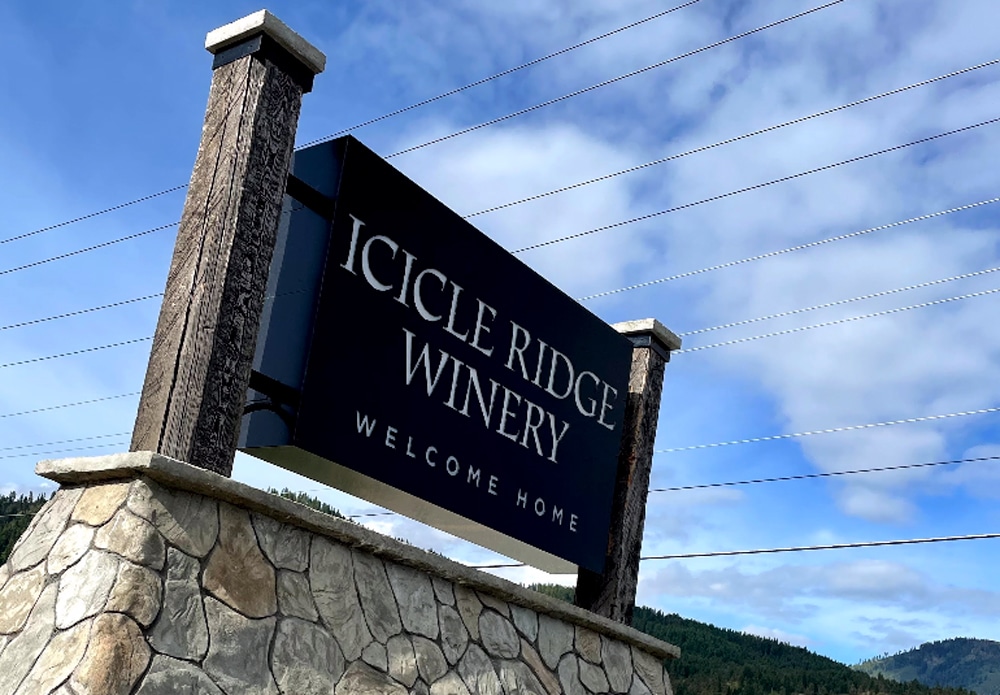
Permitted and installed in 2021, this sign today shows zero signs of settling or aging. Not needing a typical concrete foundation saved an estimated $4,000. The posts are carved mortar and the double-sided sign is high-density urethane (HDU).
These hollow faux boulders were hauled to the sign site along with the sign frame ready for installation day.
We had to dodge several underground water pipes on this job so a floating sign with “T” feet fit the bill.
This installation only took one trip and two hours on site because there was no need to pour a concrete foundation. This foundationless installation method is especially useful when the job is far away.
Rather than a large concrete footing under this sign, it simply has two treated 6 x 6-in. posts holding it up. The faux-carved granite is splatted with homemade moss and lichen. The blue background comprises 2 x 6-ft. wood boards, while all of the white lettering is HDU.
1-in.-thick mortar carved to look like stone connects to the interior posts but does not actually put any weight down on the ground, so no foundation was needed under the “rocks.”
This steel armature wrapped with galvanized lath was fabricated in our shop, then transported to the site where the mortar was applied, carved and painted.
Before landscaping was complete a portion of the “feet” can be seen on the bed of compact gravel.
This “photo-op” sign was built in our shop, transported on a large pallet, and set in place with a tractor and forks.
To save the customer money, we used four 6 x 6-in. treated posts in the ground rather than a costly concrete foundation.
The finished sign appears to have grown onsite naturally. The base is 1-in.-thick mortar, and the lettering and logo are HDU.
Two treated posts in the ground were then wrapped in stucco board on the base and ACM on the top to give this sign a solid, sturdy appearance.
The faux wood is carved and painted mortar while the rest of the sign is composed of built-up layers of HDU. This sign hovers (without a foundation) on a bed of gravel.
For more, see Rusty Gibbs’ full article, Monument Signs With No Foundation.

14 Looks at Foundationless Monument Signs
For some monument signs, instead of concrete footings, Gibbs Graphics (Leavenworth, WA) uses a “foundationless” method focused on a broad footprint, low center of gravity and substantial weight. Signs range from 30 to 200 sq. ft. in footprint and weigh 500 to 3,000 lbs. depending on materials and size, says co-owner Rusty Gibbs.
“Usually we prepare and compact a gravel base first,” he says. “From there, the support method varies depending on the site conditions. Sometimes the sign is completely free-floating. Other times we incorporate shallow hidden steel ‘feet’ slightly below grade, occasional treated posts, or tie into an existing footing if one is already onsite.”
One method Gibbs Graphics has used successfully is an upside-down T-style steel or aluminum foot beneath the sign. Two stabilized posts with wide, hidden feet can support the structure well, especially when the sign itself acts as a shear panel, Gibbs says.
“Because many of our mortar-based signs are sculpted to resemble rock or masonry, we often fabricate the armature and lath in the shop, transport it in lightweight sections, and complete the mortar work onsite,” he adds. “That avoids cranes and large equipment in many cases.”
Following are several examples of monument signs without concrete-footing foundations.
PHOTOS AND CAPTIONS BY Rusty Gibbs