
Latest AI & Technology in Signmaking
Myriad applications for both the office and shop.

ARTIFICIAL INTELLIGENCE — it’s more than just a buzzword; it’s the hottest topic in the world. Nearly all markets are feeling its transformative changes. New AI programs are being introduced daily. Those in the graphic arts industry — including signmakers — are among a growing number experimenting and implementing AI in their work, spurring an industry of AI tools from creative design to complex data. In the signmaking market, many businesses are using AI or planning to soon. While signmakers seek to leverage its benefits, they must also understand its opportunities and risks. Here are five sign businesses that have adopted its use to boost creativity, streamline processes, automate tasks and generate concepts.
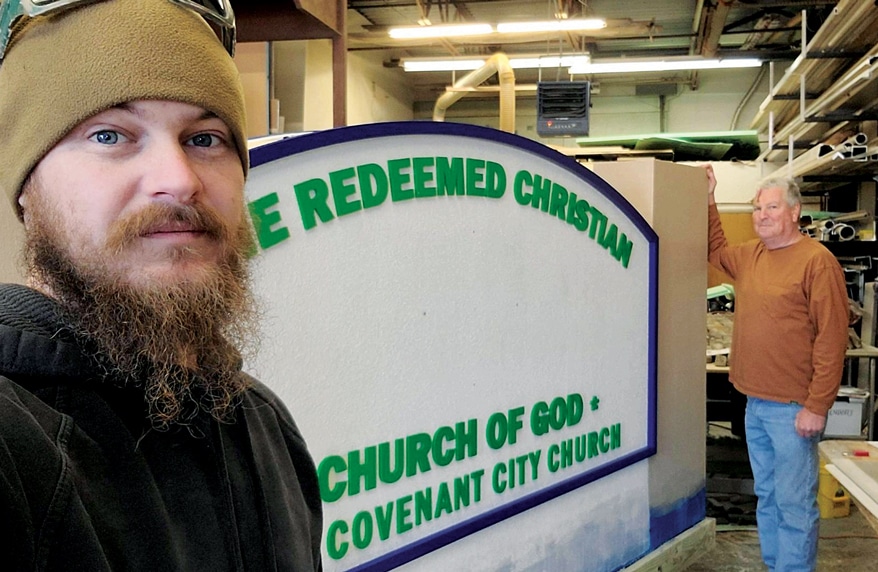 ALL IN: William Ward (left) and Tim Ward from Sign Solutions use AI for sign codes, emails, images, legal advice and more.
CONCEPTS AND IDEA GENERATION
When Sign Solutions (Frederick, MD) needed help finding up-to-date sign codes and permit requirements for an active sign project in Alexandria, VA, they turned to their ChatGPT account. What followed was a detailed list of which authority has jurisdiction, where to obtain the necessary sign regulations and approvals, how to prepare and submit the application, what the fee will cost, and how to make contact — all indispensable information gathered within a few minutes.
“I was intrigued with OpenAI as soon as it was available,” says Tim Ward, managing member of Sign Solutions. “I signed up for a paid account and we’ve been actively using it for over a year and a half.”
The four-employee company has found that AI helps to generate designs for signage. “With AI-aided design, as opposed to standard computer-aided design software, we can get something on the page within seconds to collaborate with our customers and meet expectations,” Ward says.
“Sometimes we might provide an AI-generated image just for a wow factor; although, if we can imagine it and create a digital version, we can build it. One of the more simplistic examples is writing emails. I upload them to OpenAI for review a lot,” he says. “But because I want to maintain authenticity, I find myself editing the GPT responses to meet my true character.”
Sign Solutions uses a variety of AI programs, including Leonardo AI, Napkin and Ideology. But OpenAI keeps adding new models that are integral at the company. The staff also uses Adobe Express and Adobe Firefly for new digital rendering and editing photos for presentations.
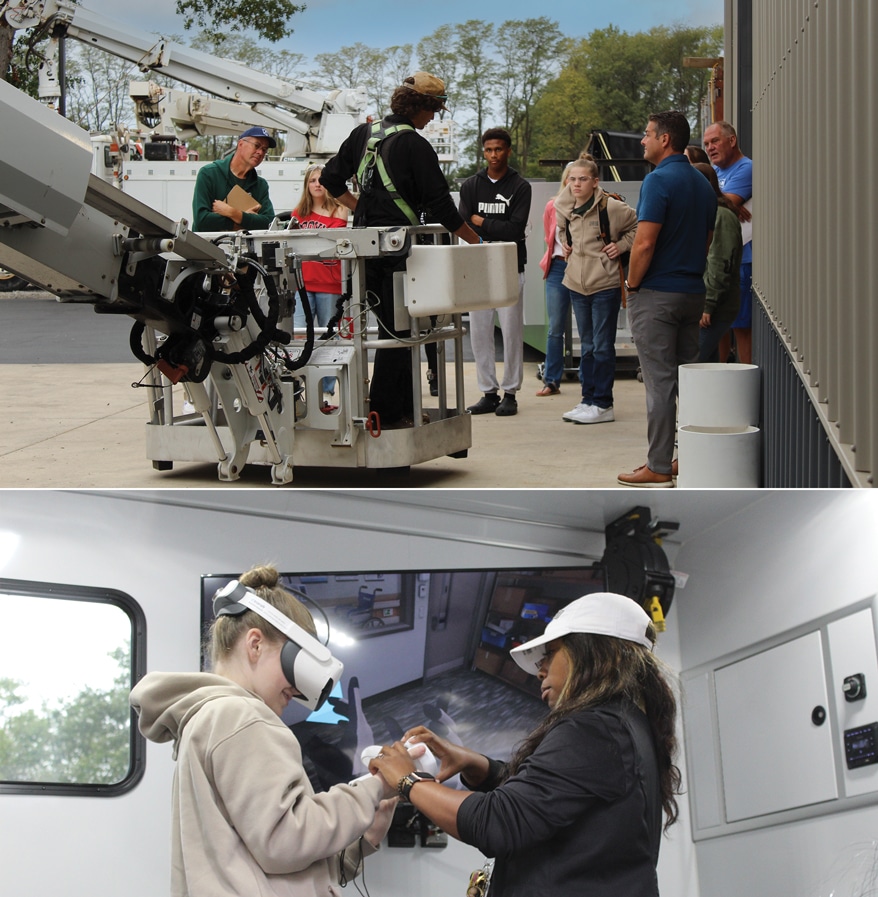 advanced & innovative: Students take in demonstrations from Legacy Sign Group employees. By the time their cohort start getting hired, AI may be a feature, not a specialty, of most sign companies.
Ward has created his own specialized databases using ChatGPT. For example, a Sign Design Assistant helps him develop ideas for materials and styles of signs. He even created a program called Architects Apprentice using ChatGPT, which helps him quickly find materials, companies and code-related documents for building additions and renovations.
To incorporate AI into his business, Ward read news magazines such as the Harvard Business Review and watched YouTube videos including those by Matt Wolfe and his site Future Tools. Ward prides himself on overseeing a company that researches equipment and advanced materials for a more energy-efficient signage fabrication process with minimal maintenance. Whenever he sees a window of opportunity, he asks his employees to upskill by learning new techniques, which include AI.

“AI has allowed us to be more efficient in our production and accessing such things as legal advice for contracts,” Ward says. “It’s also allowing us to produce more professional-looking designs, renderings and editing far quicker than before. It also provides very clear examples of existing sites with the proposed signage renderings for our clients, which makes decision-making and managing finished expectations easier and efficient. In the very near future, I can see AI helping us see text-to-3D models that will be output on our CNC machines as well as 3D printing. With AI even the smallest of companies have access to forms, process materials, flow charts and videos to level up with the largest companies.”
 an impact: Expect AI soon to touch every facet of signmaking, from sale to installation.
WRITING AND MARKETING
Legacy Sign Group in Westville, IN began to use AI in earnest last year. Their team of 33 individuals sought AI tools to assist with converting artwork to vector, 3D modeling of signage and becoming more efficient.
But AI’s benefits grew much broader than that. Legacy’s team uses AI to remove backgrounds from images or to change the sky in photographs as needed. AI solves writer’s block and helps to furnish company memos, social media posts, HR documents, sales, marketing posts and responses to customers in unusual situations.
“Our team has found value in having AI locate spelling errors in signage designs, provide formulas for use in a spreadsheet, evaluate and create spreadsheets, organize PDFs in multiple pages or remove elements from a PDF. We are also now inputting data in hopes that it will learn and be able to estimate signage faster by importing a design and having it create an estimate,” says Shaun Ensign, COO and co-founder of Legacy Sign Group.

“I anticipate automating the sales process to include prospecting, follow ups, etc.,” Ensign continues. “I really am excited about where we can take this with estimating and costing projects versus the manual methods that they are now. I’m also excited where it can go on the design and fabrication side.”
Legacy has incorporated a variety of AI programs into its business: Adobe, ChatGPT, Vectorize AI and Google. To educate themselves on the use of AI, they attended seminars through the World Sign Association (WSA) and various Chamber of Commerce events.
Ensign is aware, however, of the fear of AI eliminating jobs. But because information still needs to be input into a computer, he remains hopeful that jobs will not be lost due to AI’s technology.
What suggestions would Ensign make for other sign fabricators who want to try AI? “AI is learning and not all the information is correct. We have overcome this problem by not publishing items without a thorough review for accuracy,” he says. However, it does provide the setup of a task (getting a design on paper, structure, etc.) much faster, which can sometimes be the pain point.”
 an investment: Royal Signs & Awnings put 6 to 8 months into AI research, training and integration. The investment has paid off handsomely.
PROJECT MANAGEMENT
Royal Signs & Awnings (Houston) is bullish on AI. Their leadership not only envisions automating workflows using AI but has the data to back it up.
“We’ve been interested in AI from the start,” says Jamila Haidar, director of operations at Royal Signs. “It was a natural decision to integrate AI into our systems. The rapid advancements in AI convinced us that it could revolutionize the signage industry, and we wanted to be at the forefront of this innovation.”
The benefits have been substantial across all areas of the shop’s operations:
- Efficiency: Project turnaround times have improved by 40%, enabling Royal to take on more work without losing quality.
- Cost Savings: Material waste has decreased by 25% thanks to AI’s optimization capabilities.
- Revenue Growth: Since adopting AI, Royal’s revenue has grown by 35%, driven by increased efficiency and customer satisfaction.
- Customer Engagement: Personalization efforts have led to a 20% increase in repeat business.

To get the greatest use out of AI, Royal hired an AI consultant to guide the firm through the integration process. Royal Signs tech lead Aziz Hudedawala, who has a strong background in systems, spearheaded the design and implementation. Hudedawala and his team worked closely with the consultant to develop a roadmap, ensuring seamless integration and maximizing AI’s potential for the signage industry.
Royal admits there were some challenges along the way. The initial AI setup took about six to eight months, including research, training and integration. The company faced a learning curve in how to use AI tools effectively, which management addressed through in-depth training sessions and workshops. The upfront cost of implementing AI — covering software, hardware and talent — was also significant. However, the leadership viewed it as a long-term investment with substantial returns. A final challenge was system integration. Merging AI tools with its existing workflows required technical adjustments. Partnering with experienced AI consultants helped Royal’s team navigate these complexities.
Royal uses a mix of proprietary AI tools and customized GPT models integrated into its ERP system. This system is tailored to meet the needs of a signage company, covering everything from the initial lead to post-project customer feedback. It includes features for customer support, accounting, HR management and onboarding instructions for new hires. While there’s still room for growth, Royal’s vision is to continually evolve this into a comprehensive, one-stop turnkey solution.
 adroit info: Turnaround times sped up 40% and waste was reduced 25% after implementing AI strategies.
“The power of AI has played a crucial role in helping us achieve our goals,” Haidar says. “With a focus on enhancing design, production and sustainability, this cutting-edge approach aims to meet the demands of an ever-evolving marketplace.”
“We are dedicated to becoming the best sign company in Houston by providing an exceptional experience to our clients. With a focus on high-tech, affordable, and top-quality signs, we are constantly striving for excellence. The power of AI has played a crucial role in helping us achieve this goal,” Haidar adds.
AdvertisementART AND RENDERING
At ImageFirst Creative Sign Solutions (Grinnell, IA), a 16-employee wholesale, exterior sign company that caters to retail signage brokers, with the help of Adobe, AI is transforming their architectural signage design.
“We began to use AI mostly within the last two years as it has become more accessible,” says Nick Nelson, project coordinator/design at ImageFirst. “We aren’t trying to generate designs with it as those are typically already done by the time they get to us for manufacturing. Where it has been helpful is with Adobe Photoshop Beta since a simple text prompt allows for more efficient renderings to remove old signs or other items from a background. This allows us to show what a customer’s new sign would look like in the same location.”
“We also find ChatGPT to be helpful for terminology when presenting a quote or phrasing an email,” Nelson continues. “We have done limited testing with Notebook LM and we haven’t found the Adobe Illustrator Generative AI to be particularly helpful to us yet, but I imagine it will be in the not-too-distant future.”
ImageFirst’s team continues to learn about AI, use the technology, and expand its capabilities and processes. They have attended a few one-day workshops at a local university and a few webinars. They have certainly gained some time-saving benefits. For example, using Photoshop, a rendering can be completed 75% faster.
One of the biggest challenges faced by Nelson and his team is staying current with the evolving uses and new programs of AI. “The programs are becoming more powerful every day,” he says. “We’re always challenged by testing programs to see if they benefit us. We don’t want to be paying for something that doesn’t turn out to be helpful for us.”
It has taken them two years to learn and adapt to the basics and just get comfortable turning to AI to help make some processes more efficient, Nelson says. “As we move forward, it’s clear that AI and Adobe will continue to play a pivotal role in shaping the future of architectural signage, pushing the boundaries of design and innovation in this field. I foresee it becoming a bigger part of day-to-day processes once we find more specific applications for using it.”
 acutely instituting: Derek Atchley of Atchley Graphics is using AI in a limited sense — e.g., increasing efficiency in SOPs.
SOCIAL MEDIA AND WEBSITE
Atchley Graphics (Columbus, OH) has chosen to take a novel approach to their use of AI. While other companies are exploring what AI can do for them in many different departments, Atchley is setting a clear boundary.
“We chose to use AI in a limited sense to assist in increasing efficiency in developing standard operating procedures (SOPs), systems and processes, lists, forms and such,” says Derek Atchley, the owner, whose customers are mostly B2B. “It’s also used to some degree for social media, blog posts, copywriting or crafting marketing or email copy. We choose not to use AI, for the most part, in terms of design as we prefer to craft our work in house and by humans. We may utilize limited Generative AI in Adobe products to speed certain mundane or tedious tasks up, but never in the act of original design.”
The 16-employee company began to explore AI and how best to use it in early 2024. Today, they “keep it simple” by using Claude AI and ChatGPT, which they implemented on their own by being self-taught or performing trial runs.
“Since we generally don’t use AI for full design or marketing, we haven’t experienced any major issues,” Atchley says. “We would occasionally feel the need to humanize AI copy here and there, though.”
While limited in use, AI has brought benefits to Atchley Graphics. “It does allow us to generate basic to complex forms, SOPs, policies, etc. in a fraction of the time it normally takes,” Atchley adds. “With access to the full content of the web, its ability to handle heavy lifting for generating forms is a huge plus. Overall, based on our usage, we estimate it’s had a 10% efficiency increase in the areas we use it. Plus, it was simple to get it up and running.”
As for the future, Atchley foresees continuing to use AI on a more consistent basis in behind-the-scenes development. He will continue to set a boundary and not allow AI to take over the company’s design capacities, unless it is a tedious task augmentation, like some generative AI in Adobe products. “We do foresee it definitely increasing efficiency, accuracy and simplifying certain tasks,” he adds.
PHOTO GALLERY (13 IMAGES)



Secrets of Lead Generation
Boost your sales by generating more leads! In this light and lively webinar featuring Maggie Harlow, CEO of Signarama Louisville Downtown (Louisville, KY) and the “Business of Signs” columnist for Signs of the Times, learn the secrets of how leads are generated, where they come from and how you can cultivate better (not just more) leads.









Bulletins
Get the most important news and business ideas from Signs of the Times magazine's news bulletin.
-

 Big Survey1 week ago
How Much Are Sign Companies Charging in 2026?
-

 Big Survey2 weeks ago
How Much Are Sign Companies Paying for Materials in 2026?
-
 Photo Gallery7 days ago
125 Years of Federal Heath in 16 Images
-

 News1 week ago
Federal Heath Sign Co. Celebrates 125 Years
-

 Heidi Tillmanns1 day ago
Sign Designers Should Plan Like Builders
-

 Editor's Note3 days ago
Follow the Signs to the 2026 Big Survey
-

 News6 days ago
Chicago’s Foremost Liquors Sign Removed
-

 News2 days ago
LC Sign Launches The Touchpoint Initiative