4 Iconic Signs in the Making
Lofty and grounded signs marking destinations for years to come.

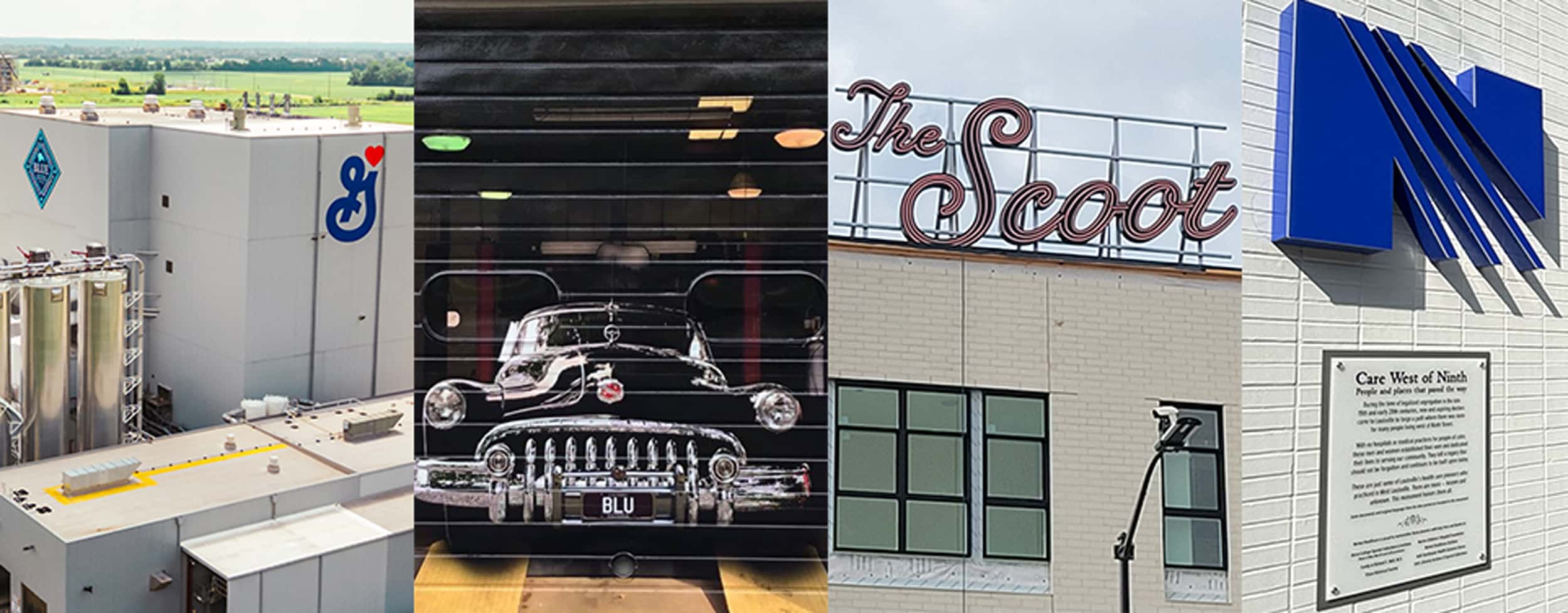
NOT ALL LANDMARKS have to be the size of Mount Rushmore to be memorable and, yes, mark the landscape. The following four sign companies have created signs of all shapes, stylings and sizes, yet these signs all share the potential to become geographical markers for passersby and visitors to the area — in some cases, they already have.
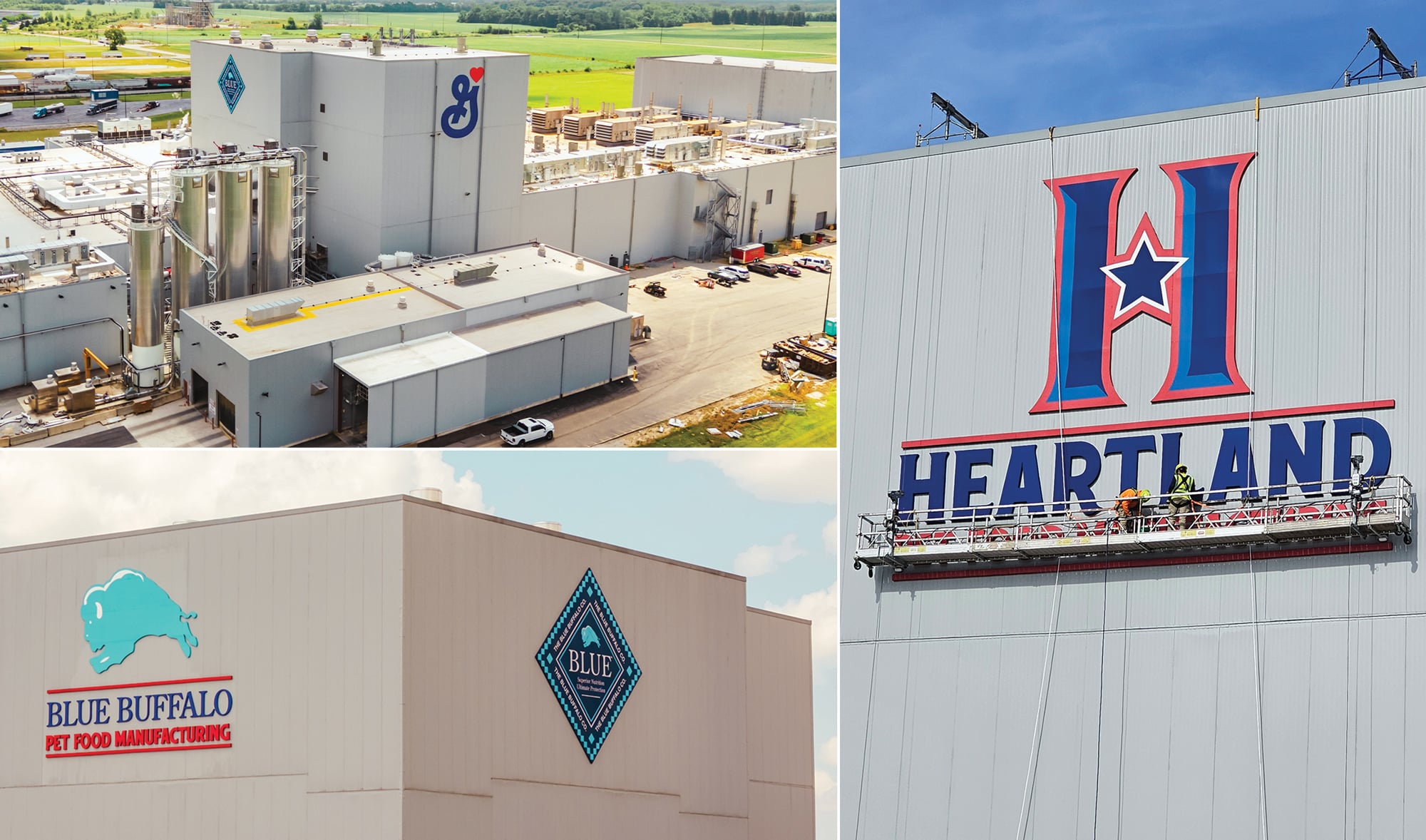
Vantage Signs (Troy, OH) was contacted to install signs on Blue Buffalo’s 137-ft.-tall mill tower, the shop’s largest project to date.
Vantage Point
Blue Buffalo, the Wilton, CT-based pet food manufacturer, originally planned to have a regional company design and produce a replacement sign on one side of their 137-ft.-tall mill tower, a new sign on the opposite side of a building addition, then have a contractor complete the installation. When that company significantly passed the project’s timeline and seemed not to be making progress, Blue Buffalo turned to Vantage Signs (Troy, OH), who were confident about seeing the project through from design to completion, says owner and project manager Trevor Lavy.
The shop was provided with a spreadsheet that included requests for approximate sizing and layout, plus a written scope of work from the previous company, without designs. The sign’s location made a traditional hands-on site survey nearly impractical, Lavy recalls, so they had to get creative to confirm sizing. “We triple-checked dimensions using scaling software, triangulating measurements and obtaining rooftop measurements,” Lavy says. Once all the numbers were in, Vantage determined that the proposed signage fulfilled only 25% of the client’s request. Thus they proposed new sizes, then set to work laying out the project and creating mockups. The new sign would measure over 25 ft. wide and the “G” logo would stand at 30 ft. tall.
Because the size exceeded their in-house production capacity at the time, Vantage worked with a fabrication partner, Alvey’s Signs (Evansville, IN), who have more experience producing large signage. They decided to build the large logos similar to the reverse-fabricated aluminum letters with ¼-in. aluminum faces and aluminum supports. The sign was fabricated in sections connected by a drop-in pin system, attached to the wall by a hidden fastener system that used heavy-duty flip toggles and brackets. Because the design of Blue Buffalo’s plant limited access to the wall’s interior, this attachment method made it possible to install the sign from the exterior alone.
“Due to the large size of the sign sections, transporting them was no small task and required multiple trailers to safely transport the sign to the site,” Lavy says. Planning for installation began months in advance, with coordination between several partners to ensure the signs would be built in time for the installation window — including contractors who were working on site on a large expansion project. Vantage enlisted the help of Jcrane Inc. (Covington, KY) to operate a Liebherr LTM 1230-5.1 275-ton crane, Vandalia Rental (Vandalia, OH) for a Genie SX-150 telescopic boom lift and American Scaffolding Inc. (Cincinnati) for the Altrex swing-stage scaffolding.

After resizing the designs, Vantage Signs determined the “G” logo would stand at 30 ft. tall.
The team set thresholds to account for the mercurial Midwest May weather, and they only had to stop work on two occasions during the two-week installation, one for rain and another for high winds. They provided a uniform radio system for all teams to communicate on-site and evacuate sections of the plant anytime overhead lifts were being made, which involved as many as six teams with up to 26 people per day. When they discovered the tower was not built to the same construction specs as initially provided during the first installation attempt, they had to update their plan and source the correct hardware as quickly as possible.
“What amazes me the most about this project was the willingness of our team to think outside of the box and meet the challenges head on, and also take on new responsibilities to raise the bar of our team’s capabilities,” Lavy says. “Thorough pre-planning is essential, but so is adaptability. Early coordination with other contractors and stakeholders avoids surprises, and even small details — like ensuring all radios connect — can make or break a high-risk install.”
As it was their first time installing signage on such scales, Vantage documented the process from start to finish, taking careful notes to study for the future. “Completing this project not only expanded our technical capabilities but also positioned Vantage Signs as a go-to partner for large-scale branding projects,” Lavy adds. “It proved to our team — and to our customers — that we’re ready for the next big challenge.”
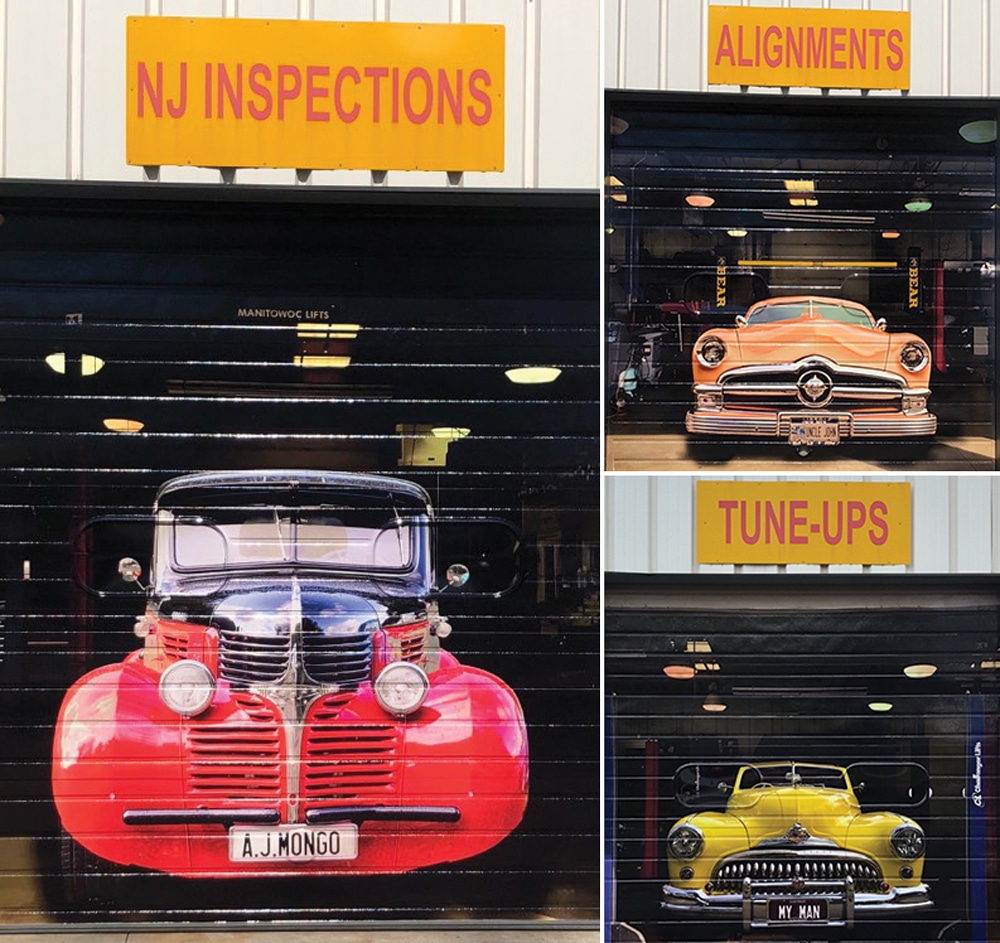
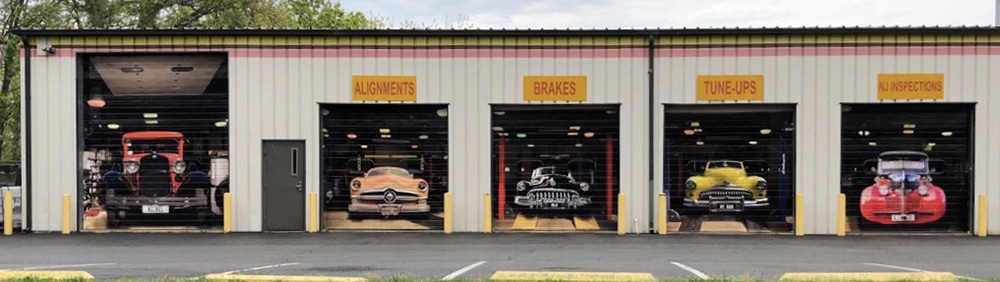
Fastsigns of Maple Shade (Maple Shade, NJ) worked with the owner of Mongo’s Tire & Auto Repair to wrap these closed garage doors, making them look as if they were opened.
The Ride Is In
When the owner of Mongo’s Tire & Auto Repair (Cinnaminson, NJ) was looking to make his establishment a landmark, he turned to Fastsigns of Maple Shade (Maple Shade, NJ), a business partner of over 25 years. Fastsigns owner Jeffrey Chudoff devised the idea to wrap the closed garage doors with images of cars being worked on inside, making the repair center appear as if opened. He photographed the empty garages, then used Adobe Photoshop to superimpose pictures of client cars on the graphic, which they printed on Avery Dennison MPI 1105 Wrapping Film using Roland’s VersaEXPRESS RF-640 and laminated with their KALA laminator.

Prior to the installation, the garage doors were pressure-washed and allowed to thoroughly dry. The Fastsigns of Maple Shade team worked in the morning because direct sunlight in the afternoon would make the graphic too stretchy, Chudoff says. Installation took two days to complete.
“Care is the best lesson to teach clients,” is Chudoff’s advice to other signmakers. “A wrap is like skin: It just needs to be washed and moisturized!” The building has since become a notable landmark for car owners who frequent the spot on the weekend — when the repair center is closed — for photos.
Advertisement
Sign Effectz (Milwaukee) installed this 20-ft.-wide rooftop sign with retro-inspired illuminated lettering.
Luxury Living
Through personal connections, Sign Effectz (Milwaukee) was contacted to fabricate and install a 20-ft.-wide retro-inspired illuminated sign on the rooftop of The Scoot Grandeur Apartments (Cudahy, WI). Company designer Adrian Esguerra worked with fellow Milwaukee-based architectural firm Rinka on the project designs, which also included wall signs built from 48 x 60-ft. ACM panels with vinyl graphics and an extruded aluminum “Snap Frame” to hold the panels in place, an aluminum pan measuring 48 ft. round and 2 in. deep with FCO PVC letters and vinyl for small copy, and two sets of vinyl address numbers measuring 3.63 in. tall and 12 in. wide.

Sign Effectz used a Grove 100-ton all-terrain hydraulic crane, another 17-ton hydraulic crane and a 72-ft. Wilkie bucket truck to hoist the signs in place. Prior to installation, the biggest challenge they faced was obtaining occupancy permits for vehicle and pedestrian traffic control, which required additional planning, applications and approvals. However, the team pulled off the project without a hitch, their pride and passion shining through as it took shape. “Don’t let projects scare you. With precise planning and execution, just about anything is possible,” advises Sign Effectz project manager Michael Quill.

Unified Sign and Design (Louisville, KY) fabricated and installed monument signs commemorating the area’s medical history.
Panels of History
Unified Sign and Design (Louisville, KY) was contacted for monument signs commemorating medical history through their relationship with Norton Healthcare, which opened Norton West Louisville Hospital in the city’s west end in October last year — the historically Black neighborhood’s first hospital in over 150 years. The monument would act as a gateway to the facility and illustrate the development of medical care in the area, honoring healthcare workers and pioneers in the late 1800’s and early 1900’s who served marginalized populations.
“We work closely with them, handling much of their interior ADA signage across their facilities,” says Unified Sign owner Sarah Dixon. “Because of this strong partnership, they reached out directly with the initial architectural rendering for the monument sign and asked if we could incorporate it into our existing scope of work for the hospital’s interior signage.” The monument signs were designed by Moody Nolan (Columbus, OH), with the panel contents provided by Norton Healthcare’s marketing department and refined by the signshop to better align with their messaging.
The foundational supports were built from welded steel frames to ensure structural stability for the large brick-and-metal monument. Large-format acrylic prints comprised the decorative and informational elements, with each section containing two pieces of acrylic: one mounted to the steel structure’s front, another to the back, all showcasing historical photos and documents. “This configuration created a noticeable depth between the images and effectively protected the printed surfaces from environmental exposure,” Dixon says. The shop applied the graphics onto the acrylic using a reverse-print technique with their Canon Arizona 2300 UV flatbed printer.

Due to the size and weight, the shop contracted a local crane company to install the signs using specialized lifting equipment. The subsequent work, which included panel mounting, leveling and finishing, was performed from ground level by Unified Sign’s in-house installation team. The area around the foundation was a high-traffic zone for other trades as the hospital was nearing completion, which limited the hours when the crane contractor could safely operate, Dixon recalls. So they planned the installation outside of peak construction hours, scheduling the crane lift early on a Saturday morning.
“What stood out most was the seamless coordination with the general contractor’s team. Their willingness to accommodate our revised schedule allowed us to complete the complex lift safely and efficiently, minimizing disruption to the overall project timeline,” Dixon says. “Given the highly finished, reverse-printed acrylic panels, we learned that you can’t be too careful with packaging.”
She advises other signmakers to invest in custom-built, hard-sided crates or vertical-panel racks for projects that use large, high-gloss acrylic pieces. This would minimize the risk of scratches, chips and fingerprints during transport, on-site storage and final installation, saving time on touch-ups and replacements.
“As a certified woman-owned business, we were deeply grateful to be included on a project that highlights the significant achievements of minorities in our community,” Dixon remarks. “Being part of an initiative that visually celebrates this diversity, especially for an institution as vital as Norton West Louisville Hospital, aligns perfectly with our company’s values and makes this project one of our proudest accomplishments to date.”
Another reference point for years to come.
PHOTO GALLERY (16 IMAGES)






Secrets of Lead Generation
Boost your sales by generating more leads! In this light and lively webinar featuring Maggie Harlow, CEO of Signarama Louisville Downtown (Louisville, KY) and the “Business of Signs” columnist for Signs of the Times, learn the secrets of how leads are generated, where they come from and how you can cultivate better (not just more) leads.





Bulletins
Get the most important news and business ideas from Signs of the Times magazine's news bulletin.
-
 Dale Salamacha1 week ago
Sign Company’s Fire-Inspection Fiasco
-
 Russell Toynes1 week ago
Better Sign Design
-

 Maggie Harlow4 days ago
5 Ways to Show Up as a Helper
-
 Electric Signs3 days ago
3 Contemporary Channel Letter Sign Solutions
-
 Mark Kissling5 days ago
Daunting Sign Cabinet Retrofit
-

 True Tales5 days ago
Sign Company Says “No” to Critical Error
-

 News2 weeks ago
Mimaki Creates Collectibles for LIV Golf Club
-

 Manager's To Do1 week ago
Mid-Year Analysis Leads To-Do Lists for July-August