Connect with us

Metal Fabrication

Flex Installation

Three real-world installations

Published

on

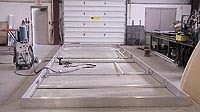
The Play’s the Thing Playhouse Square Center hired Wagner Electric Sign Co. (Elyria, OH) to create a spotlit wall sign. Wagner instead suggested an internally illuminated, flexible-face sign, and the client agreed. During fabrication, the sign company first constructed a 10 x 36-ft. welded, aluminum cabinet in two sections and determined lamp placement.

With the cabinet assembled, Wagner’s Jim Borer installed lamp sockets. According to Paul Drury, the company’s director of sales and marketing, horizontal lamp positioning keeps water from running down the lamps into the sockets.

For this job, Wagner ordered white, Ultralon flexible-face fabric, which the company seamed together in-house. Wagner then built a custom frame into which it tensioned the material. Onto the fabric, staffers applied premium, 3-mil, non-translucent black vinyl. "The Resident Companies Playhouse Square Center" lettering is light-blue translucent vinyl.

Each of the six resident-company graphics measures 6 x 8 ft. and comprises two digital images printed onto clear 3M vinyl by Ariston (Springfield, NJ). This photo depicts Wagner’s Jody Hall wet-applying the graphics. If you look closely, you can see where she is seaming together the two "Great Lakes Theater Festivals" prints.

At the top of the photo, you can see the sign cabinet. On the truck, Wagner’s Barry Morgan prepares to unload the frame holding the flexible face. Because the frame is long, it was unbolted and bent for transport. Drury says bending caused no damage to the fabric. "It straightens out fine. Just be careful you don’t pinch or tear the flexible face," he explains.

Wagner installed the sign cabinet onto the wall of the Cleveland Playhouse Square Center. A photocell ensures the sign comes on in the evening; a timer turns the sign off at a specified time. Also, note the sockets into which the lamps fit.

Designed by Kapp & Assoc. (Cleveland), the finished sign — with its frame attached to the cabinet — made its theatrical debut. Drury offers advice to companies considering similar projects: "Double-check the compatibility of your vinyl with your fabric. Some vinyl manufacturers won’t warranty their product on just any flexible face."

Northern Exposure

Although Selkirk Signs (Cranbrook, British Columbia, Canada) constructed this KalTire identification sign with only one, 100-in.-wide panel, that panel was 26-ft., 6-in. long.

Selkirk graphics manager Bob Learmonth says the shop handles illuminated, rigid plastic faces, pan faces, molded letters, routing metal, wood and plastic signs. Selkirk has increased its out-of-town work, especially through Canadian gas companies, such as Esso, he says. Selkirk makes signs and ships them all over Canada, often using pre-printed vinyl.

Production manager Barry Nadain says the shop often butt-joins and heat-tapes panels together for larger signs, as this procedure is less noticeable and more translucent for backlit signs than sewn panels. "We’ve been here for 12 years, and we’ve never had a problem yet with the panels," Barry says. "It’s the copy that breaks down first."

Like most flexible-face signs, the KalTire sign was stretched in-house by tensioning clips snapped onto an adjustable serrated edge, then tightened with a stretching tool.

Bob says Selkirk used SA International’s Inspire Inspire

Advertisement

SPONSORED VIDEO

Secrets of Lead Generation

Boost your sales by generating more leads! In this light and lively webinar featuring Maggie Harlow, CEO of Signarama Louisville Downtown (Louisville, KY) and the “Business of Signs” columnist for Signs of the Times, learn the secrets of how leads are generated, where they come from and how you can cultivate better (not just more) leads.

Promoted Headlines

Most Popular