Business Management
AI Is About to Change Sign Estimating
Are you already behind?

 PHOTO: ISTOCKPHOTO
This article was written by Brooks Digh, FSG Signs (Austin, TX) and Texas State University (San Marcos, TX).
AFTER FINISHING A COST estimate for a bid, I’m always left with the same question: What margin should I put on the costs? If I put a lower margin on the bid, I’ll be more likely to win, but I’ll also come away with less profit at the end. If I go with a higher margin, I’ll walk away with more profit if I do win, but then I’m less likely to win. This trade-off between raising margins to maximize profit and lowering margins to maximize the probability of winning makes this problem difficult to solve.
Traditionally, this decision is left up to estimators to guess at, but how good are they at choosing a margin that optimizes both profit and win probability? This problem has been studied in academia since the 1950’s, but those methods generally require access to not only your own historical bidding patterns, but also your competitors’. I don’t know about other companies, but I definitely do not have access to a large database of our competitors’ past bids. So, if we can’t see the competition’s data, how can we possibly know what margin gives us the best balance between winning and profit?
What if the answer isn’t in that competitor data — but in our own?
The first problem that needs to be solved is identifying the value we are truly trying to optimize. With any optimization problem, you need a clear goal. Maximizing the chance of winning a bid is actually very easy: You simply bid the lowest margin you are allowed to bid. On the other hand, maximizing the profit you would earn if you did win is also very easy: You just bid the highest margin you are allowed to bid. But neither of those is really what we want to do; we want to maximize expected profit.
Expected profit is actually a simple concept — it’s the amount in dollars you would earn if you win a bid multiplied by the probability that you’ll win the bid. So, for example, if at a given margin you would make $20,000 in profit and the probability of winning at that margin is 50%, your expected profit would be $10,000. Finding the value that maximizes expected profit allows us to strike a balance between optimizing for profit and optimizing for win probability.
But this raises another question: how do we estimate expected profit? Determining what the profit would be for a given margin is a simple calculation, but determining the probability of winning a bid at that margin is anything but simple. So how do we estimate something we’ve never directly observed, especially without competitor data?
That’s where AI comes in
I’m going to spare most of the technical details and just give you the basics so you can understand how this works. I’m working on a much longer — and probably much more boring — academic paper, if you’re interested in all of that. At a high level, artificial neural networks are a type of AI model that learns patterns in data and uses those patterns to make predictions. These are the same kinds of models behind tools like ChatGPT, Grok and Gemini — but instead of generating text, we can train them to answer very specific business questions.
In this case, I’m training a model to predict the probability of winning a job based on factors like labor cost, material cost, applied margin and previous sales with a customer. Just to be clear, I’m not asking ChatGPT, “What’s my chance of winning this job?” — that won’t work. Instead, I’m training my own model using our historical bid data so it learns how margin and job characteristics relate to winning or losing. Once the model is trained, I can use it to estimate the probability of winning a new bid at any given margin.
Predicting the probability of winning
Figure 1 makes it very clear what the neural network is doing. I’ve had to hide the actual margins that we bid at, but you still get the idea. The model predicts the probability that we will win the bid for every margin in the allowable range. At the lowest margins we are allowed to bid, the probability of winning is nearly 100%. As the margin increases, the probability of winning gradually decreases until it reaches nearly 0% at the upper end of the range. It’s also important to remember that this isn’t just a generic representation of every job we bid. The model is taking into account all the job features, such as material cost, labor cost, distance to the customer and much more.
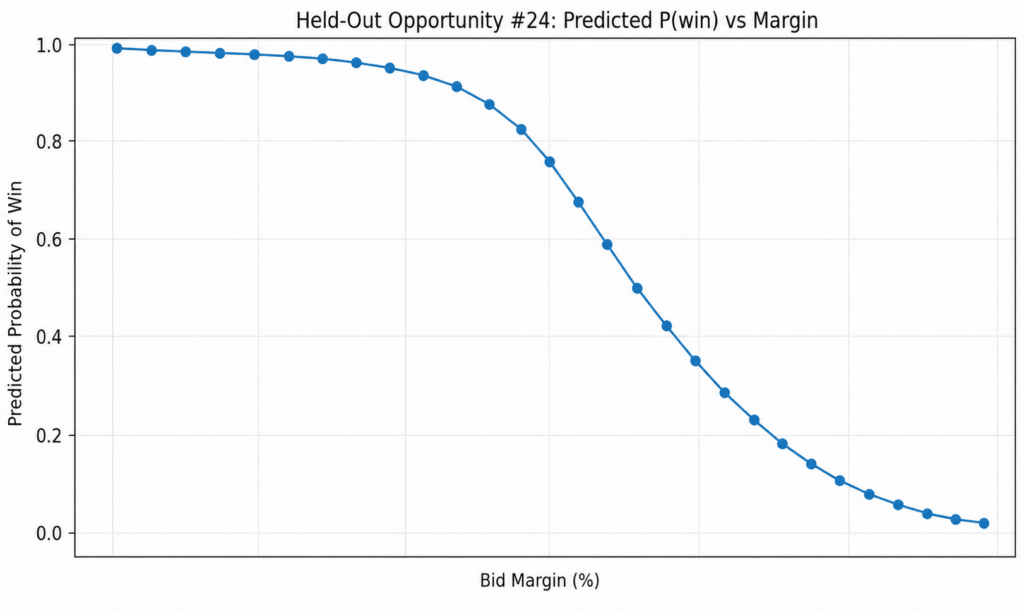
Figure 1: Predicted probability of winning an opportunity vs. the bidding margin as predicted by the artificial neural network.
Expected profit at a given margin
But again, just knowing the probability that we will win the bid at each margin is not enough. If we want to guarantee we win a bid, we already know that bidding at the lowest allowable margin is the best decision. But now that we do know the probability of winning at every margin, we can multiply that probability by the profit we would make if we were to win the bid at that margin to get Figure 2, which shows the expected profit in dollars for each margin we could bid on. Now our decision is simple — we only need to pick the margin that maximizes expected profit (the highest point on the graph). Again, the actual margin is hidden here, but you can see that the best margin to bid at is not the lowest or highest allowable margin. It’s somewhere in the middle. What’s even more interesting is that the best margin for this bid is not the same best margin for every bid.
Advertisement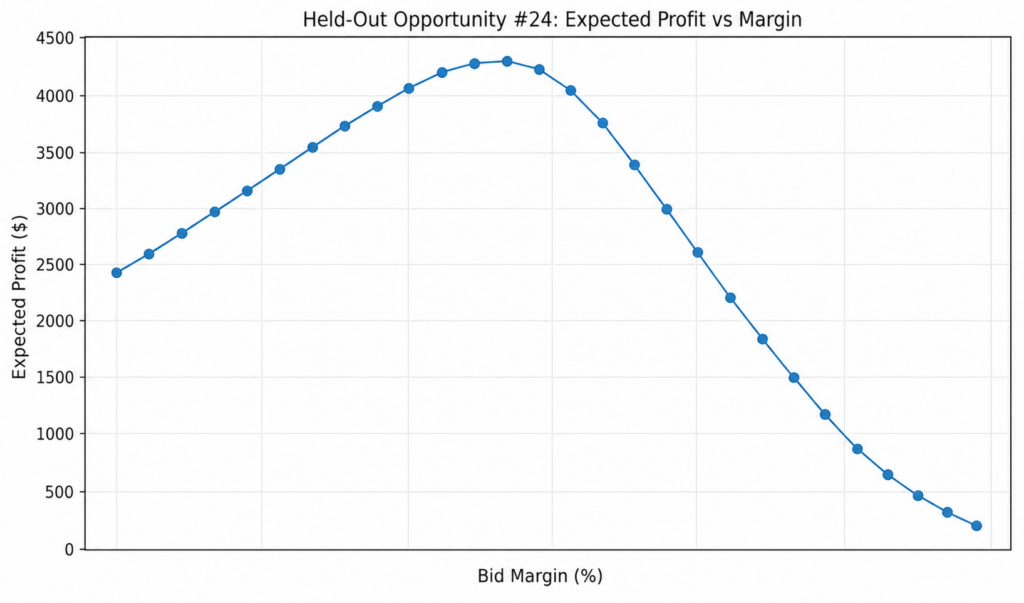
Figure 2: Expected profit if a job was to be won at a given margin vs. the bidding margin. The highest point on the graph represents the best expected profit as determined by the neural network.
Bidding with the same (“flat”) margin
Bidding with flat margins — that is, choosing one margin and using it for all jobs — is a very common technique. But now that we know the margin that maximizes expected profit is different for each bid, we can safely assume that choosing a single margin for every opportunity will not maximize our expected profits. But how bad is it in comparison?
Figure 3 shows just how much money you can be leaving on the table by bidding with flat margins. Using my model, I calculated the total expected profit for every bid in my dataset at every margin. For example, at a 30% margin, I calculated the probability of winning each job in the dataset, used that probability to determine the expected profit in dollars, and then summed those values across all bids. This creates a curve showing the total expected profit for every margin in the range.
Here, the best flat-margin bidding strategy results in a total expected profit slightly below $1.6 million. This is the best possible outcome using flat margins. I then selected the optimal margin for each bid as determined by the neural network and summed the expected profit at those margins across all bids. Now, the total expected profit exceeds $2 million.
I hope this makes it clear just how powerful this AI model is. Even with the best possible flat margin, it still falls short of the AI model by almost half a million dollars. That’s not a rounding error — that’s the difference between a good year and a great one.
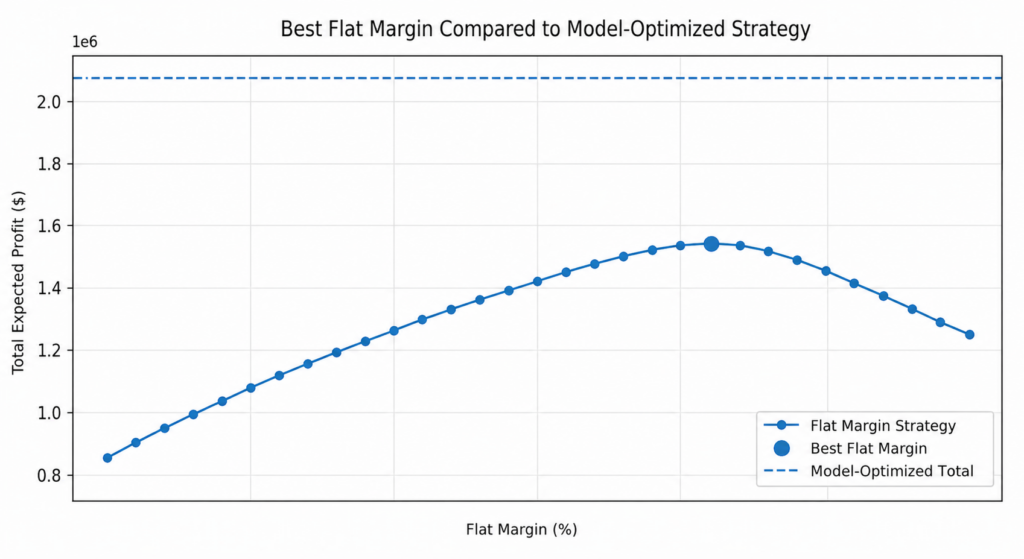
Figure 3: Total expected profit across all bids in the dataset for every flat bidding margin strategy and as predicted by the neural network. The figure shows that the neural network outperforms even the best flat margin bidding strategy by roughly $500,000.
The future of estimating
Since I entered the industry, estimating margins has been treated as a matter of experience and intuition. The best estimators develop a “feel” for what will win and what will make money, but even the best intuition is still a guess at an invisible number: the probability of winning. What this approach shows is that the problem was never unsolvable — we were just missing the right tool.
Artificial intelligence doesn’t replace the estimator. It doesn’t replace judgment, relationships or experience. What it does is give us something we’ve never had before: a way to quantify the tradeoff between winning work and making money, using only the data we already have. And that changes everything.
Because once companies begin making decisions this way, the competitive landscape shifts. The companies using data-driven estimating will consistently choose better margins, win the right jobs and leave less money on the table. The companies that don’t will still be guessing — not because they aren’t good, but because they haven’t adapted to how the game is changing.
We at FSG Signs have already started moving in this direction, and it’s already changing how we make decisions.
The question isn’t whether AI will change sign estimating — it’s who adopts it fast enough to come out on top.
For a similar analysis by Brooks Digh, see “Your Signshop Floor Doesn’t Need a Task for Everything.”
Advertisement

Secrets of Lead Generation
Boost your sales by generating more leads! In this light and lively webinar featuring Maggie Harlow, CEO of Signarama Louisville Downtown (Louisville, KY) and the “Business of Signs” columnist for Signs of the Times, learn the secrets of how leads are generated, where they come from and how you can cultivate better (not just more) leads.






Bulletins
Get the most important news and business ideas from Signs of the Times magazine's news bulletin.
-

 News4 days ago
2026 Sign Contest Open for Submission
-

 Russell Toynes7 days ago
Is AI Coming for Sign Designers?
-

 Monument Signs6 days ago
Monument Signs With No Foundation
-

 Real Deal7 days ago
One Signshop’s Installers Approach Another Shop
-

 Photo Gallery7 days ago
14 Looks at Foundationless Monument Signs
-

 Video5 days ago
Paid Day Off to Find Another Job
-

 Benchmarks3 days ago
5 Industry-Changing Historic Signs and Techniques
-

 Product Buying + Technology2 weeks ago
Digital Sign Displays and EMCs