Mark Kissling
Phoenix Shopping Center Sign Connects With the Past
Inspired by and reinterpreted from 1955’s originals.

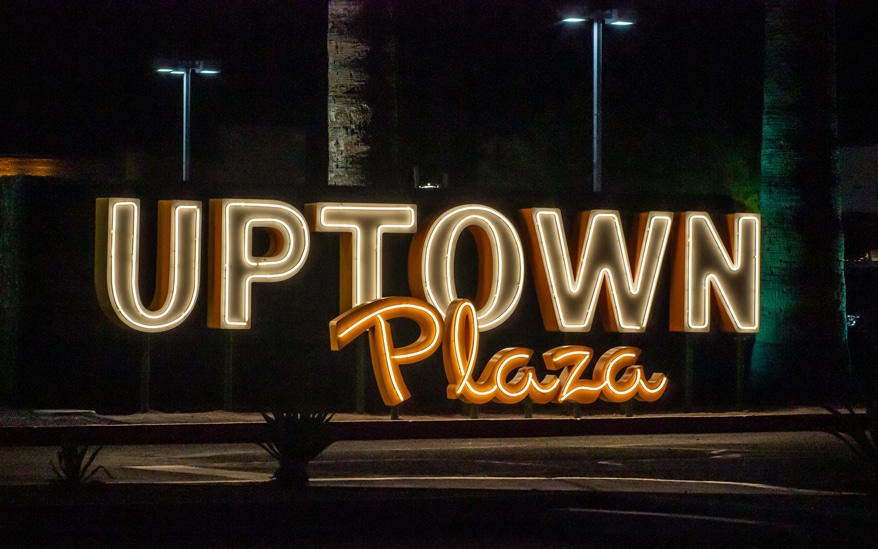 The sign conveys a mid-century charm, which is just right, as Uptown Plaza dates back to 1955.
IT’S UNCOMMON TO see an approach framed by large, mature trees leading to a defined visual focal point, especially within a smaller development like Uptown Plaza — one of the oldest (est. 1955) shopping centers in the Phoenix metropolitan area, according to Josh Condon, business development for hometown Trademark Visual. “Our design direction pulled inspiration directly from legacy signage while reinterpreting it for a modern audience,” he says.
Beginning with a referral, this was Trademark Visual’s first project with Levine Investments, a local real estate developer. The shop focused on staying true to the original logo and color palette by incorporating the historic green and yellow, along with exposed faux-neon elements.
“While we would have preferred to use true neon, we ultimately selected LED contour lighting due to the sign’s height and the heavily trafficked environment,” Condon says. “There were safety concerns around potential glass breakage and public exposure.”
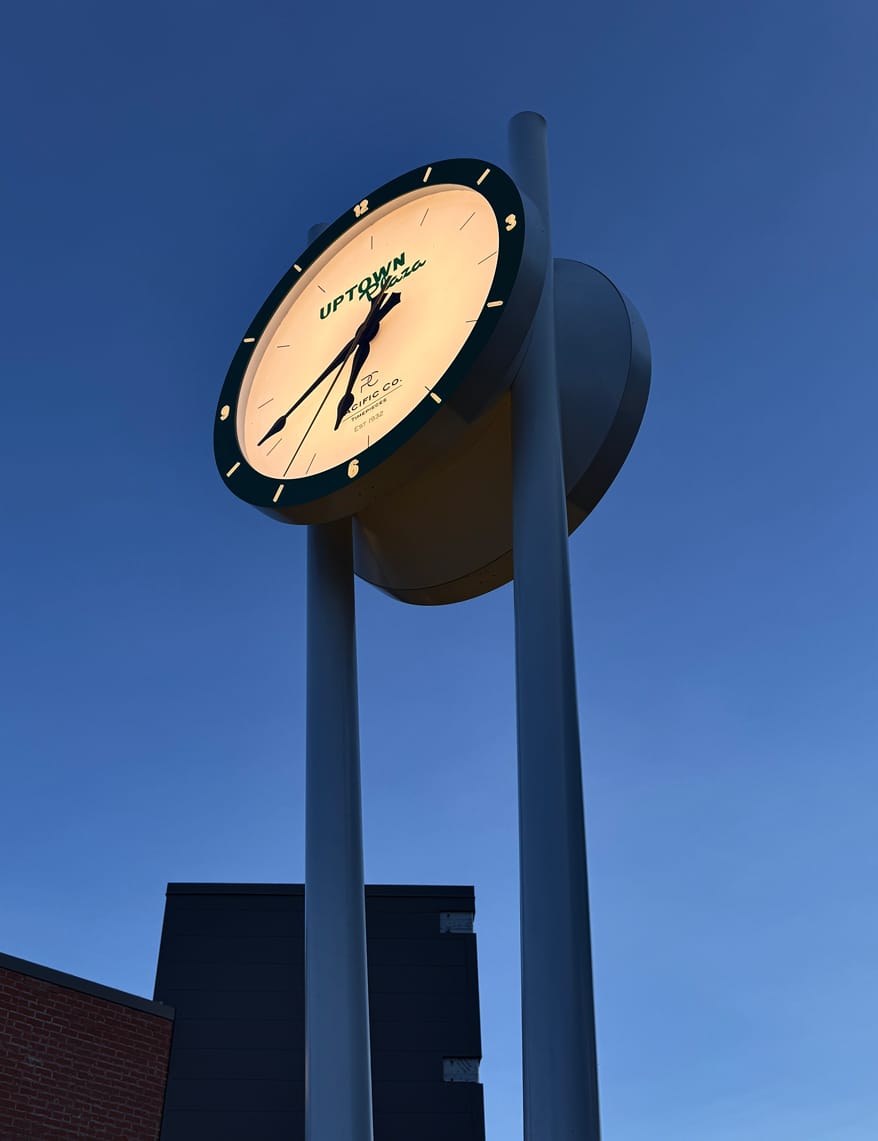
This clock became a passion project for Trademark Visual’s lead fabricator Howard Vail, who considers it one of his favorite builds.
Condon designs the majority of his projects as well. He developed initial concepts using SketchUp, V-Ray and Photoshop to accurately visualize the sign in context. The final shop drawings were produced in Illustrator and CAD.
Trademark Visual’s team hand-bent and fabricated the letters, with all power supplies housed internally and conduit routed between each letter. GE Current Tetra Contour LED contour lighting was applied to the letter faces. They also incorporated an internal structural system to increase rigidity, including an internal match plate that allows the letters to mount securely to the poles, Condon says.
The sign measures 20 ft. wide, with 3 ft. 5.5-in.-tall UPTOWN letters, making the top of the sign 5 ft. 7 in. off the ground.

The installation process was relatively straightforward. A full-scale paper template was used in advance to precisely locate each anchor point. Individual mounting plates aided in anchoring the letters to the footing. Following the footing pour, installation of the letters was completed in one day, with an additional day required to complete the electrical connections between letters.
Condon notes that when the sign was originally installed, they used uplighting rather than faux neon. “At the time, we believed this approach would better protect the lighting from potential tampering due to its proximity to grade,” he says. “However, it quickly became clear that the result lacked the visual impact we were aiming for, which led us to pivot to the current solution.”
Advertisement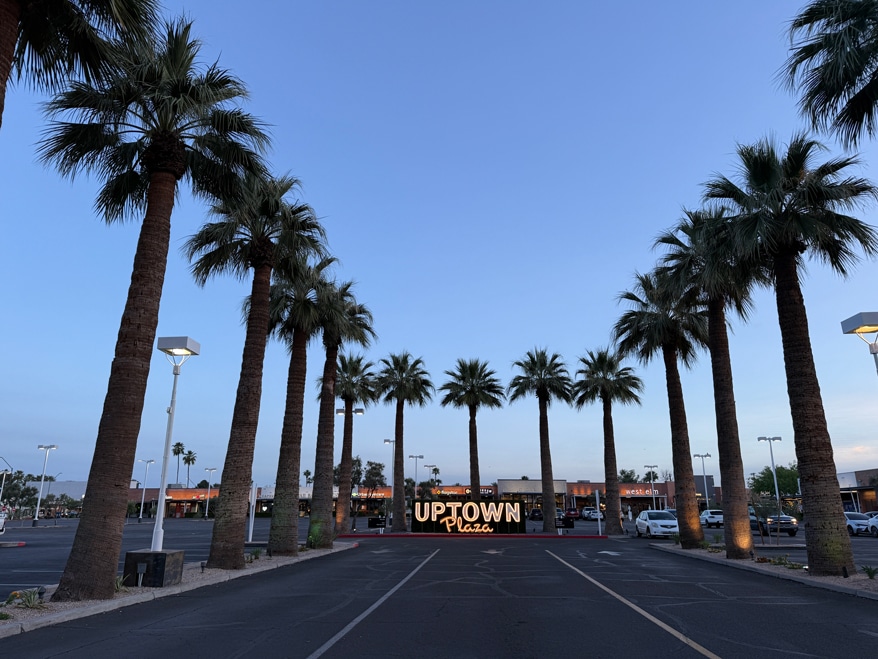
In another part of the project the client wanted a strong vertical element that would act as a marker, something timeless.
“The intent was to create a focal ‘moment’ within a back-corner common area where people gather, whether waiting for restaurants, attending events or entering from the neighborhood,” Condon says. After several concepts were explored, the shopping center clock quickly became the preferred direction. “It stands as a vertical beacon, with an illuminated face and structural cues that tie into the existing canopy architecture on site. The level of precision required, particularly with the complex angles, cone geometries and intersecting supports, made it a standout fabrication effort,” Condon adds.
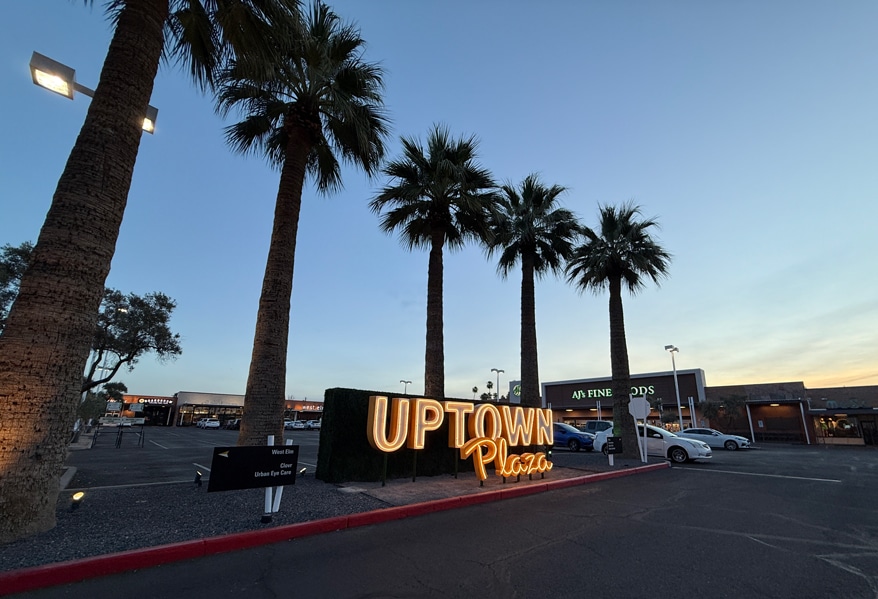
He advises doing your research when working on older projects. Also, take lighting studies with a degree of skepticism, especially for exterior applications. “Always test uplighting conditions on-site prior to final installation,” he says. “It’s nearly impossible to fully predict how lighting will interact with surrounding ambient conditions and material reflectivity without real-world testing.”
Just as impossible is predicting what will happen to a project after completion. During a recent visit to Uptown Plaza, Condon noticed two separate shoes somehow lodged at the top of the clock between the support posts. “That definitely wasn’t part of the design intent,” the designer in him says.
Advertisement

Secrets of Lead Generation
Boost your sales by generating more leads! In this light and lively webinar featuring Maggie Harlow, CEO of Signarama Louisville Downtown (Louisville, KY) and the “Business of Signs” columnist for Signs of the Times, learn the secrets of how leads are generated, where they come from and how you can cultivate better (not just more) leads.



Bulletins
Get the most important news and business ideas from Signs of the Times magazine's news bulletin.
-

 Business Management6 days ago
Alternative Management Advice for Sign Companies
-

 Fabrication + Installation4 days ago
Small Signshop, Big Fabrication
-

 Paul Ingle2 weeks ago
120 Years of Signs, and I’ve Seen 41 (Mostly)
-

 Dale Salamacha2 weeks ago
A Gen Z’er Ready for Work
-
 Mildred Nguyen1 week ago
Interior Reimage Transforms Georgia School
-

 True Tales1 week ago
My Shirt Says “Signs”
-
 Maggie Harlow1 week ago
3 Steps for Performance Appraisal Preparation
-

 Manager's To Do2 weeks ago
Summer’s Varied Sign To-Do List for June