Mark Kissling
Goodyear Blimp Centennial Wrap
An Akron, OH shop prepped and installed the first-ever famous blimp wrap.

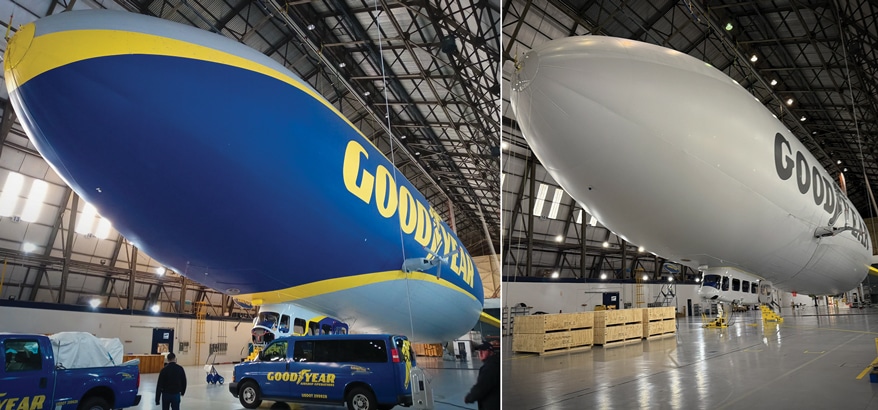 BEFORE | AFTER: A Goodyear Blimp in 2024 with painted graphics (left) and the same blimp in 2025 wrapped with custom-engineered vinyl.
IN JUNE 2021, Goodyear Airship Operations (Mogadore, OH) contacted nearby Central Graphics (Akron, OH) after seeing the shop’s marketing email featuring wraps for kitchenettes, walls, appliances and more. Central’s Director of Sales Joseph Kist followed up on the inquiry, assuming Goodyear was interested in graphics for their cafeteria, but when he arrived at their facility, he was escorted deeper inside. Along the way, someone noticed the tape measure he was carrying and said, “That won’t help you for this project.” Finally, Kist reached some hangar doors. As they opened, he found himself face-to-face with a Goodyear Blimp, docked with its nose pointed straight at him. That’s when the Goodyear folks said, “This is the project we called you about…”
The signshop has worked with Goodyear in the past on fleet graphics for the support vehicles for the three Goodyear blimps, along with FAA [Federal Aviation Administration] number designations on the stabilizer wings, says Central Graphics Managing Director Jeff Loofboro, the lead on this project. Central had also worked on a large-scale project on Goodyear Airship N3A to refresh the yellow logo and striping. Traditionally painted, Goodyear wanted to try vinyl graphics, Loofboro says. The successful completion of that project led to this one.
“The blimp wrap has been over a year in the making, with Central Graphics workers wrapping the airship in a new color scheme inspired by the company’s first branded blimp in 1925, the Pilgrim,” says Dave Soulsby, Central Graphics CEO. “The tour launches June 3, which is the official anniversary of the company’s foray into the blimp business.”
For this project, the design work was relatively minimal, limited mainly to redrawing the 1925 hand-drawn logos provided by Goodyear, according to Bill Lynn, Central’s creative director. “We can’t forget that in the era of these early airships, there were no digital files, just pounced and handpainted enlargements of hand-drawn logos!” he says. Using Adobe Creative Suite (mainly Illustrator) with occasional support from CorelDRAW, the shop scaled the historic logo proportionately to the modern logo. Due to the massive scale of the airship, there was no need to modify the graphics to accommodate for curvature, Lynn says. Each letter in the logo stands approximately 10.5 ft. tall, with the full logo measuring 105 ft. wide by 18.25 ft. high.
Advertisement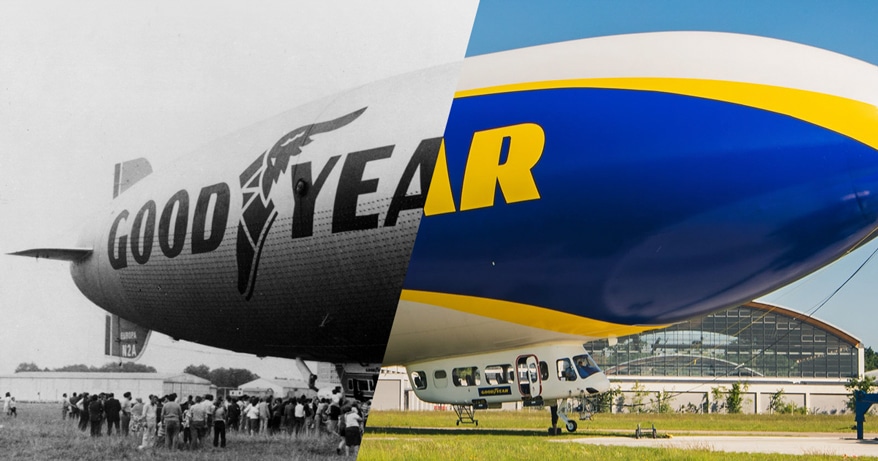
A closer look at not only how the new gray graphics covered the previously painted logo, but also two valves and one of the motors to be installed around.
A new film without a name produced by Mactac was custom manufactured for this application, Loofboro says. Characteristics considered during development and testing were the thicknesses of the face film and adhesive, since weight is of concern for a blimp, as well as opacity since the wrap would be covering up yellow and blue paint. Slideability of the film and initial adhesion on the blimp surface, and removability after one year were also important. “During testing, the technical guys at Mactac quickly adjusted all aspects of the film time after time until it was approved for use on the blimp,” Loofboro says.
Mactac also custom-produced and color-matched the vinyl in gray and black, allowing Central Graphics to avoid printing, except for the house flag graphic, Lynn says. “Our team then prepared the panel layouts and contour-cut files, sending the vinyl rolls to the Colex for precision cutting,” he adds. Central Graphics had to predict the total weight of the vinyl ahead of time to determine if it fell within the parameters they were looking for, Loofboro says. Then they had to weigh all the film, scrap, boxes and cores to come up with a final weight, which came to 364.55 lbs.
The principal challenges of installing the wrap included working with large panels up to 25 ft. long while maintaining a consistent overlap, working around obstructions such as wings, motors, valves and other work being done on the blimp, as well as working upside down. Central needed a skillful and dedicated crew able to handle the panels and the conditions, and still maintain the highest-level care and quality, Loofboro says. The project kept six installers busy for about four weeks. The entire project timeline from Goodyear was only three months, Solusby says.
From the ground up, experiment with films repeatedly on your walls, vehicles, airships, etc., Soulsby advises. “We cannot stress testing enough, then pull the trigger and trust your install team,” he says. This project involved many overnighted samples, many trips, many lift rides up to the blimp, Loofboro says. “We test vinyls for standard wall and vehicle wraps, but this was much more detailed,” he adds.
For more photos of Central Graphics’ 100th Anniversary Goodyear Blimp wrap, see signsofthetimes.com/062507.
PHOTO GALLERY (9 IMAGES)



Secrets of Lead Generation
Boost your sales by generating more leads! In this light and lively webinar featuring Maggie Harlow, CEO of Signarama Louisville Downtown (Louisville, KY) and the “Business of Signs” columnist for Signs of the Times, learn the secrets of how leads are generated, where they come from and how you can cultivate better (not just more) leads.







Bulletins
Get the most important news and business ideas from Signs of the Times magazine's news bulletin.
-

 Big Survey1 week ago
How Much Are Sign Companies Charging in 2026?
-

 Big Survey2 weeks ago
How Much Are Sign Companies Paying for Materials in 2026?
-
 Photo Gallery6 days ago
125 Years of Federal Heath in 16 Images
-
 News7 days ago
Federal Heath Sign Co. Celebrates 125 Years
-

 Editor's Note3 days ago
Follow the Signs to the 2026 Big Survey
-
 News5 days ago
Chicago’s Foremost Liquors Sign Removed
-
 News2 days ago
LC Sign Launches The Touchpoint Initiative
-

 Paula Fargo6 days ago
Your Brand Is More Than Your Logo