AFTER THE CAD AREA, the next step in many a new sign’s life cycle is the fabrication area where parts will be constructed into letters, cabinets, monuments and other features. This area can pose many new challenges and must be organized accordingly. One notable facet of this second step is the parts received from the CAD area being officially considered WIP (work in process). These are parts not completed in production but with labor, overhead and raw-material costs applied. Another unique trait of fabrication is encompassing many different processes that use different types of WIP from the CAD area: letter backs, faces, cabinet parts, mounting plates and FCOs (flat cutout letters). An effectively organized fabrication department must be able to handle all of these incoming parts, ensuring they go to the correct personnel and process areas. Following are some strategies to ensure your fabrication department remains organized and efficient.
Overall Layout
Typically, unless your shop has an extremely large CAD area or multiple indoor paint booths, fabrication will occupy the majority of your shop space. Because a fabrication department can be tasked with multiple processes including welding, lighting, gluing, assembly and packaging, it’s critical that layout is thoroughly considered. In February I highlighted some common shop layout styles, including process focused, product focused, fixed position and cellular (see ST, February 2026, page 19). Our shop handles less production work and focuses more on custom and semi-custom small batch runs, so we primarily use a process-focused layout, with some cellular-layout practices used as well. Process-focused layouts group similar processes together and are normally used in custom-fab shops, and cellular layouts group together small teams that focus on one part, or a small subset of parts, that can be adapted regularly to changing product demands. The combined use of these strategies comprises the organization plan for our shop’s fabrication department.
Advertisement
Fabrication Department Breakdown
The process-focused layout in our shop can be broken down into three categories: Large/Heavy, Medium/Common and Small/Specialty. All three process areas fulfill a specific role to ensure we can produce a wide variety of signage.
- Large/Heavy Fabrication: Area designated for the largest and most-robust signs.
- Allotted the most amount of space to allow for overhead cranes and moving large structures.
- The closest/easiest access to structural material such as aluminum or steel tube and angle.
- Appropriately equipped welders in this area able to work with both aluminum and metal.
- Larger workbenches with heavy-duty castors used for optimum ergonomics and adaptability.
- Considerations for fire and crushing risk taken extra seriously.
- Medium/Common Fabrication: Area used for the most prolific letter sets, small cabinets and blade signs.
- Static layout to promote consistency.
- Designed around repeated processes.
- Tools, hardware and electrical supplies easily accessible from designated storage spaces.
- Quality checks and final packaging laid out in a consistent procedure.
- Small/Specialty Fabrication: Area optimized for small, detailed and specialty work, where cellular layout occasionally comes into play. This area is set aside from the rest of the shop in a closed-off environment that has superior lighting and reduced dust debris.
- Specialty tools stay in designated spots in this area.
- Benches designed for sitting comfortably for detailed work.
- Space is set aside for quick, specific area configuration for specialty one-off projects.
Remember that all these areas and the entire layout concept can be adapted to fit new parameters. All it takes are a few large clients to get excited about a new type of sign that our shop does not currently focus our production effort on. Markets and trends change, and a fabrication shop must be ready to change with them.
Advertisement

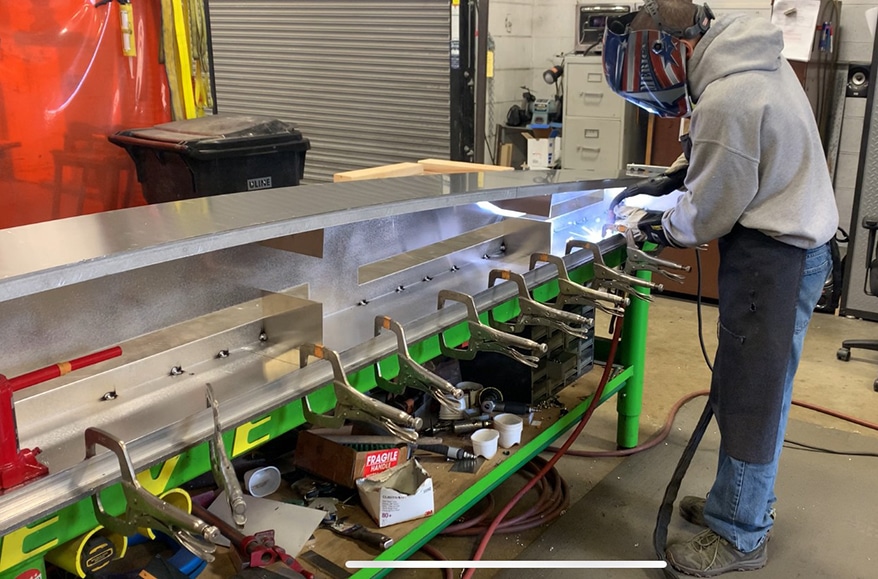 Welding in process in North American Sign’s fabrication department.









 Russell Toynes1 week ago
 News2 weeks ago
 Maggie Harlow5 days ago
 Business Management2 weeks ago
 Electric Signs1 week ago
 Mark Kissling1 week ago
 Dale Salamacha1 week ago
 Signs of the Times2 weeks ago