Illuminated Signs
Money, Politics and Local Joy: The Story of Exeter’s IOKA Theatre Marquee
An incredible journey from landmark to derelict to museum star.

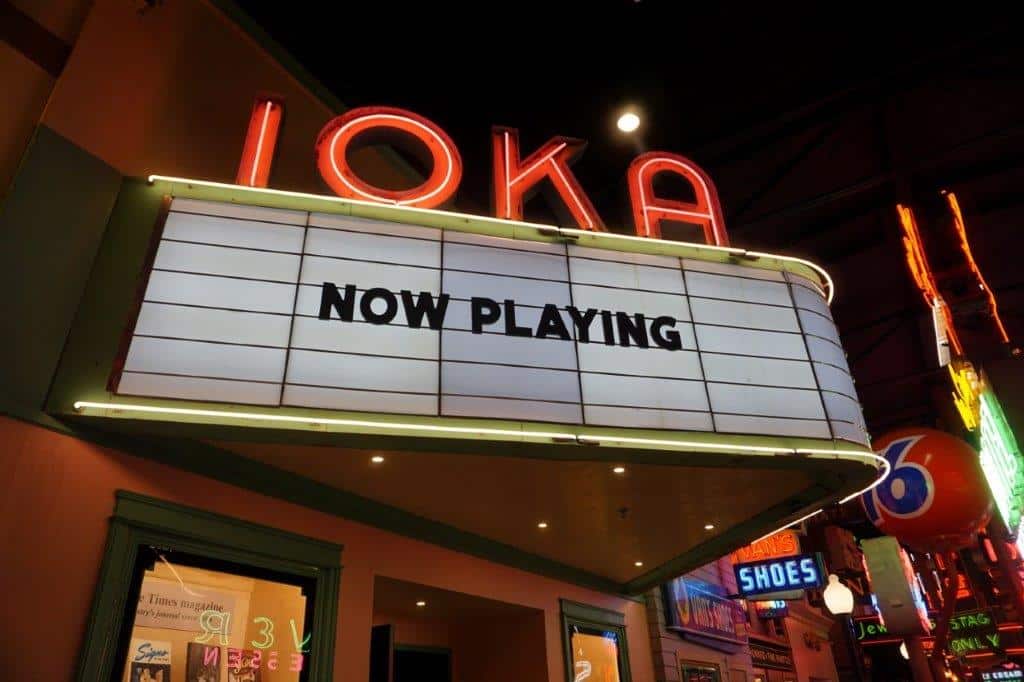 The restored IOKA Theatre marquee unveiled at the American Sign Museum (Cincinnati) on July 12, 2024. Photo by Laurie A. Couture.
For decades, the IOKA Theatre with its neon-lit marquee was one of three town square icons that injected character into Exeter, a small town in New Hampshire. Its good fortune was not to last: Repeated changes in ownership, building code issues and freak weather all contributed to its steady decline, resulting in the marquee’s removal to the townfolk’s chagrin and sorrow.
“In the 1990s, I worked there as a 15-year-old with my best friend. Working at the theater was like entering a world. Once you work there you are indelibly tied to the place,” says Laurie A. Couture, children’s mental health counselor and arguably the marquee’s fiercest, most outspoken champion. “It was just a fascinating place. To be able to go up the ladder and take those giant cast iron letters and change them, the sound they would make, to be up close to the neon… I just totally fell in love with the marquee and the theater.”
Couture walks us through a complete timeline of the marquee from its heyday through its removal and eventual restoration.

The IOKA Theatre in 1989. Photo by Laurie A. Couture.
A Historic Landmark
Judge Edward D. Mayer ordered construction of a vaudevillian theater that began in April 1915, with a contest held in the community to name the theater. A Camp Fire Girls scout named it IOKA, incorrectly thinking it a Native American word for “playground.” The theater officially opened on Nov. 1 that year, featuring a blade sign on the side of the building.
The first sign of trouble came when Mayer skipped town in 1916, owing Exeter thousands of dollars. Ownership of the theater then belonged to the Ralph Pratt estate throughout the 1920’s. The first talking motion pictures were shown at the theater in March 1929, which became a major attraction for locals. Couture’s grandmother Wanda recalled seeing a bunch of movies with friends at the theater in 1938 when she was 10 years old, she says.
A 19.6-ft.-wide art deco marquee with antique Wagner letters and neon was installed circa 1938-1941. This marquee, the one that Couture and Exeter townsfolk most fondly remember, was originally sea green with blue and yellow accents on large letters. After falling on hard times, the theater closed in 1965 and again in 1972 following another transfer of ownership. In 1987, James E. “Jim” Blanco, who worked at the theater as a young boy two decades prior, became its manager and kickstarted the first restoration process: He had the marquee repainted into its original palette, and had the electrical system and signboard modernized. It was under his management that teenage Couture and her best friend Brenden Sanborn also came to work at the theater, which regained the popularity it had enjoyed in its halcyon days: Movie tickets frequently sold out, and patrons sometimes formed long lines that stretched down the sidewalk and around the corner.
This popularity led to further expansion in 2000, when Club Ioka opened in the basement with a second screen. Blanco commissioned a “mini marquee” with neon, functional removable signboard letters and spins. In 2005, he sold the theater to Roger Detzler. Faced with the requirement of a new sprinkler system, Detzler sold off all antique artifacts and attempted to sell the marquee, which was stopped just in time by the Historic District Commission of Exeter.

The mini marquee that Jim Blanco commissioned for Club Ioka, Dec. 2008. Photo courtesy of Laurie A. Couture.
Decline and Removal
A freak storm with baseball-sized hail destroyed the marquee’s neon in 2006, and the theater permanently closed two years later following steep decline and building code violations. Los Angeles-based artist Marc Murai began a fundraising campaign to save the IOKA and turn it into a community arts space in 2009, but the effort failed despite the high amount of money raised. The bank foreclosed on the theater in November 2011, and it went to auction the following month where it was bought by Alan Lewis, a local philanthropist. Efforts to save the IOKA restarted in earnest that year with the formation of The Exeter Theatre Co., including Laurie and her late son Brycen, who loved going to the theater until it showed its final film on his 15th birthday. As marquee managers, thus among the only townspeople allowed to enter the theater at the time, the mother-son duo put up fundraising messages on the marquee.

Laurie and her son Brycen celebrating at the Save the IOKA Rally on March 31, 2012. Photo courtesy of Laurie A. Couture.
The fundraising and rally campaigns proved massively successful. With memberships of over 1,340 from across the country, the Exeter Theatre Co. met the requirement for Lewis to “gift” the IOKA to the group for $1. However, in April 2013, Lewis announced that the deal for the theater was off and that he was seeking a “preservation partner.” For the next seven years the theater sat vacant and decaying, water leaking in, signboard cracking, and the marquee painted a gaudy neon green, Couture says.
In March 2020, at the onset of the Covid-19 pandemic, David Cowie and Jay Caswell purchased the IOKA with plans to turn it into condos overlooking the picturesque Exeter river on the top floor, retail space on the bottom floor and a speakeasy in the basement. To Couture’s concern, the marquee was not part of the plans. In June she led a petition campaign that generated over 2,600 signatures in favor of saving the marquee, as well as a Facebook group for this singular purpose. She also produced videos calling for Exeter residents to speak up at July’s Historic District Commission meeting, where she submitted documents to be an intervenor for the marquee. The New Hampshire Division of Historical Resources, New Hampshire Preservation Alliance and several preservation-minded allies rallied behind her — including Jared Guillmett, an architect who had preserved a 1930 Colonial marquee in Laconia, NH. The commission voted in favor of the marquee remaining on the theater regardless of redevelopment.
The fight did not end there. “I ended up in a quagmire of unbelievable politics. We were punted to the Zoning Board of Adjustment. There were four town meetings we ended up with,” Couture says.
The zoning board eventually overruled the commission’s mandate for the marquee. “They took it down and I was crying … it was just a mess,” Couture recalls. “There was talk of the sign being chainsawed to pieces, the IOKA letters to be sold. All I could think of was, my son tragically died in 2017. I thought of my Nana who passed away in 2007. I thought of all the years I went there with my friends, all the memories and the years of working there.”
As rumors circulated that the marquee posed a safety issue, Couture consulted with local Portsmouth Sign for an expert opinion. The signshop was among the parties she contacted — including attorney Scott Hogan, members of the Exeter Town Code and Planning staff, former owner Jim Blanco — as the new theater owners filed paperwork with the Exeter Select Board to request removal of the marquee for safety reasons. Couture also filed with the commission, which approved temporary removal of the marquee while the owners appealed to the zoning board. The marquee was to be stored and restored to the building should the appeal fail.
“Things got so heated on social media that we had to divide our Facebook group into ‘Inner Circle’ helpers and general supporters, as people were going back and forth to sabotage our efforts,” Couture notes in a timeline of events. The campaign was a true multimedia approach, involving handmade posters and T-shirts in addition to gift card raffles, trivia contests, local businesses, businesses and helpers from all walks of life.
Early morning on Aug. 14, 2020, the marquee was removed from the theater and driven to a storage facility. The zoning board ultimately overturned the Historic District Commission’s ruling, accepting that the marquee should be dismantled apart from one of the IOKA letter sets, which was to be installed on the building as signage. The Exeter Historical Society, which had stayed out of the campaign up to that point, wanted the other letter set, Couture says.
She did not give up. In September she pleaded her case with current building owner David Cowie, which involved using replica letters and finding a new home for the marquee. Cowie agreed to store the marquee while Couture sought a willing recipient, preferably one located in New England. She contacted neon museums and dealers around the country, though concentrating her initial efforts on New Hampshire, where a Milford restaurant owner expressed interest as his building used to have a marquee. Turns out the IOKA marquee was too long and deep, and its triangular shape would protrude into coming traffic. “We tried to find a place for it in Massachusetts and Maine, Vermont, Connecticut. We couldn’t find [any] because all these buildings were built very long ago and had specifications. Even industrial buildings didn’t want it,” Couture recalls.
Advertisement
Save the IOKA Rally in Exeter, NH, March 30, 2013. Photo courtesy of Exeter Theatre Co. Archive via Laurie A. Couture.
New Beginnings
Eventually Couture talked to Dave Waller, a neon sign restorer in Boston, who connected her to American Sign Museum (ASM, Cincinnati) founder Tod Swormstedt. Swormstedt told Couture he had always wanted a theater marquee for the museum but never found one that was the right size. Nevertheless, approval to use replica marquee letters, to be installed on the building, had to go through the Historic District Commission before the marquee could be fully released, which was approved in May.
June 23, 2021, sign experts disassembled the IOKA marquee and loaded it onto a big rig. The rig left the storage unit in the afternoon, and Couture followed it on the I-95 through Massachusetts for nearly 15 minutes before heading home. “It was very heartwarming that the driver, HotShot Bennii, stayed in contact with me through the trip,” Couture says.

The IOKA Theatre marquee being disassembled for its trip to Ohio, June 23, 2021. Photo courtesy of Laurie A. Couture.
The marquee arrived at the ASM two days later, whereupon Couture informed the local papers, IOKA marquee supporters and the Exeter Town Office of the news. A newly fabricated set of letters spelling I-O-K-A modeled after the original were soon placed on the right side of the building, and the Inkwell Cafe opened inside the refurbished building this year with balcony views of the Exeter River.
While the ASM set on restoring the marquee, construction to rehabilitate the IOKA building began in January 2024. A new façade was installed on the building in March, with the “Mayer Bvilding” placards moved to the top and a row of windows put in place where the marquee used to be. The marquee’s neon was restored to full illumination again for the first time since 2006. On July 12, Couture attended the VIP unveiling of the ASM’s Main Street expansion, which the IOKA marquee — looking just like it did in the ’40s — and its specially constructed mini theater have called home since.
“The marquee and the IOKA will be forever connected — they’re just in different parts of the country. Because of its connections to my family, it mattered to me, what it stood for for over 80 years. All of the energy it absorbed and generated in its heyday,” Couture says. “We went to all this trouble to preserve human memories and human culture. It’s a perfect representation of the art deco era — now it’s preserved in a museum for probably longer than any of us will be alive. To me that was a story of unity and working together.”

The restored IOKA Theatre marquee unveiled at the American Sign Museum (Cincinnati) on July 12, 2024. Photo courtesy of Laurie A. Couture.

Secrets of Lead Generation
Boost your sales by generating more leads! In this light and lively webinar featuring Maggie Harlow, CEO of Signarama Louisville Downtown (Louisville, KY) and the “Business of Signs” columnist for Signs of the Times, learn the secrets of how leads are generated, where they come from and how you can cultivate better (not just more) leads.




Bulletins
Get the most important news and business ideas from Signs of the Times magazine's news bulletin.
-

 Russell Toynes1 day ago
Is AI Coming for Sign Designers?
-

 Maggie Harlow2 weeks ago
Secrets to Connecting With Sign Customers
-

 Mark Kissling2 weeks ago
Phoenix Shopping Center Sign Connects With the Past
-

 Real Deal1 day ago
One Signshop’s Installers Approach Another Shop
-

 Product Buying + Technology6 days ago
Digital Sign Displays and EMCs
-
 Signs of the Times1 week ago
Signs of the Times at 120 Years
-

 Brain Squad1 week ago
Brain Squad Forum Ep. 2: Hard-Won Lessons From the Front Lines
-
 News2 weeks ago
Vectorized Alf Becker Alphabets Available