Jeff Waggoner is director of environmental-graphic design for FRCH Design (Cincinnati). Joe Smallwood is regional-sales manager for Triumph Sign and Consulting (Cincinnati).
At least a dozen signs, which identify hotels, banks and other prominent corporate headquarters, dot the Cincinnati skyline. Why would FRCH Design, a local design firm, choose to develop a sign to compete with these titans?
Why not?
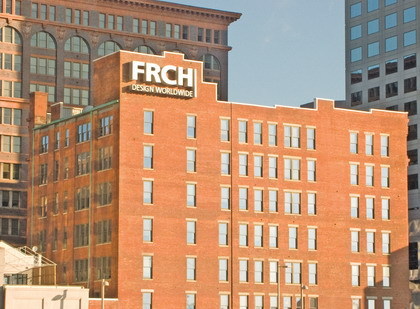
Our story began in June 2006, when FRCH CEO Jim Tippmann pursued installing a sign atop the south-facing wall of the firm’s seven-story building at 311 Elm St. Duke Realty Corp., the building’s owner, had offered the building’s signage rights to another building tenant.
Cincinnati’s building codes require a variance for any sign above the ground floor in the city’s Fourth Street Historic District. FRCH quickly formulated a design and added it to Duke’s variance-request submittal for both tenants. The Historic District Conservation Board approved the proposal, and Triumph submitted a fabrication quote and project budget.
More is more
Advertisement
Although the initial sign had received approval, the firm’s partners pondered whether to build the initial sign design or make revisions. Because of the building’s excellent exposure to Cincinnati’s riverfront and Paul Brown Stadium, home of the NFL’s Bengals, an inevitable question arose: From what distance would the FRCH sign be legible?
FRCH downloaded a Google Earth image of downtown Cincinnati and created a radius to calculate the distance from which a sign could be viewed. The firm used the time-honored formula of 1 in. of letter height equaling 30 ft. of legibility distance. The original design featured 32-in.-tall letters, which achieved only partial visibility within the stadium and fell well short of the Ohio River.
To revisit the entire design process, the FRCH design team visited the River Center across the Ohio River in Covington, KY. The club provided the perfect vantage point to survey the riverfront’s signage successes and failures. They quickly learned that many signs weren’t legible from that distance. Creating signage that would project distinctly across the water became a priority.
A new face
Concurrently, the firm’s marketing department evaluated the logo as part of a branding initiative. Therefore, FRCH reconsidered the sign’s entire composition. Over a six-month period, the firm considered numerous illumination types — from laser beams to massive LED displays — while its designers reworked the logo. They developed sign designs and priced out what these sources would cost to create optimal visibility.
Advertisement
FRCH estimated that an 8-ft.-tall letters were needed for visibility from Covington. How could we use such large letters and still bring an aspect of design that would separate our sign from the normal pan channel letters? Tim Smith, FRCH’s graphic-design director, formulated the answer: 34-in.-deep returns.
Using a Miller Weldmaster heat-welding system, Triumph built the channel letters using 0.063-in. aluminum for the returns and 0.090-in. material for the backs. To create additional letter stability and aid LED placement, they constructed 0.090-in., internal baffles. For the letter faces, Triumph router-cut ¼-in.-thick, polycarbonate sheet with its AXYZ Automation CNC router.
The redesigned logo incorporates a vertical bar on the right side. To impart a theatrical element, FRCH specified programmable RGB LED light tubes for the bar. They specified DMX-controlled Magic Lite mini-tubes and a 12VDC power supply. FRCH settled on a default, color-spectrum cycle to illuminate the bar.
Using the SketchUp® Photomatch™ feature, FRCH simulated different views and distances. Triumph used 570 of SloanLED’s high-output Great White 2 LED modules to illuminate the letters. We selected LEDs to reduce energy and service costs.
Clearing hurdles
Advertisement
FRCH’s executive committee approved the design, so the firm wanted to ensure the sign’s affordability. Triumph created an estimate for the reworked project. The new design nearly doubled the first template’s pricetag, but everyone agreed it justified the cost. The 34-in.-deep returns and the equipment required to install such large heavy letters on a 100-year-old brick building accounted for much of the increase. Triumph designed an aluminum-tube, grid-mounting system to minimize crane time and reduce the number of holes needed to affix the sign to the aging brick wall. Triumph painted the grid to match the brick wall.
The sign’s significant changes required a second trip to the Historic Conservation Board for approval. Initially, city officials refused our request, but we arranged a hearing with the board. There, FRCH representatives met with neighboring property owners to answer questions. After much consideration, the board approved the design. Perhaps FRCH’s 40-year commitment to downtown favorably influenced them.
Triumph Sign finally commenced production in August 2008. However, Magic Lite’s delivery lag imposed the first hurdle. They promised a six- to eight-week turnaround; however, offshore production problems extended the window to 14 weeks. Because no alternative suppliers for this product existed, we adjusted our schedule.
Triumph assembled the sign in three sections – “FRCH” in one section, the “Design Worldwide” subhead another and the color-changing bar as the third – and hauled it on a flatbed trailer. The ready-made components required minimal onsite assembly.
Worth the wait
To install the 1-ton sign, Triumph used 35- and 50-ton hydraulic cranes. Because of the sign’s late-fall installation, scheduling required close attention to the weather forecast to prevent wind and precipitation from hindering the job. To access the building’s small parking lot for the installation, FRCH employees parked cars offsite. The lot’s steel gate only exceeded the cranes’ width by 6 in.; installers maneuvered the cranes slowly into place.
To bolster the 28.5-ft.-long sign against wind shear (permissible shear per bolt can’t exceed 17,622 psi), Triumph used 1/2-in.-diameter, A307 anchor through-bolts with backing nuts and washers. City inspectors verified the bracket-tube welds and the anchor bolt’s tightening.
FRCH unveiled its sign on December 1, 2008 — a mere two and a half years after conception. During difficult times, it’s especially important for a company to convey its brand proudly. FRCH believes the sign reflects its position of strength as a distinctive provider of design solutions.
Equipment and Materials
Coating: Grip-Gard acrylic-polyurethane coating, from Akzo Coatings Inc. Sign Finishes (Norcross, GA), (770) 662-8464 or www.signfinishes.com
Cranes: Link-Belt 35- and 65-ton hydraulic cranes, from Link-Belt Construction Equipment Co. (Lexington, KY), (859) 263-5200 or www.linkbelt.com
Hardware: Anchor bolts, nuts and washers, available at building-supply stores; pop rivets and screws, available from building-supply and home-improvement stores.
Lighting: Great White 2 LED modules, from SloanLED (Ventura, CA), (888) 747-4533 or www.sloanled.com; programmable LED light tubes, from Magic Lite (Oakville, ON, Canada), (905) 825-9592 or www.magiclite.com
Router: CNC router, from AXYZ Automation (Burlington, ON, Canada), (800) 361-3408 or www.axyz.com
Software: FlexiSign Pro, from SA Intl. (Salt Lake City, UT), (800) 229-9066 or www.saintl.biz; Photoshop CS3, from Adobe Corp. (San Jose, CA), (800) 833-6687 or www.adobe.com; SketchUp Pro 3-D modeling software, available via download at http://sketchup.google.com
Substrates: Aluminum sheet (0.060 and 0.093-in.), from David Hirschberg Steel Co. (Cincinnati), (513) 831-0514 or www.davidhirschbergsteel.com; Lexan® ¼-in.-thick polycarbonate, from SABIC Innovative Plastics (Pittsfield, MA), (413) 448-7110 or www.sabic-ip.com
Welder: Weldmaster heat sealer, from Miller Weldmaster Corp. (Navarre, OH), (877) 935-3628 or www.weldmaster.com
About the Authors
As FRCH’s director of environmental graphics, Jeff Waggoner oversees the firm’s graphic-design direction and processes, project management and production coordination. During his more than 30 years of environmental-graphic-design experience, his portfolio has included programs for Hilton Head Co., Adobe, 3Com Systems, Kaiser Permanente and San Diego Children’s Hospital.
Joe Smallwood serves regional-sales manager for Triumph Sign Co. He began his sign career as an installer with Sign Vision in 1993, where his work entailed installing neon channel letters and highway signage. Next, he took a sales position with Cincinnati’s Holthaus Signs in 1997 before joining Triumph in 2005. His work includes transitioning Cincinnati-based Federated Department Stores’ rebranding to Macy’s, and Nations Rent’s changeover to Sunbelt Rentals.











 Big Survey2 weeks ago
 Photo Gallery1 week ago
 News2 weeks ago
 News5 days ago
 Heidi Tillmanns4 days ago
 Editor's Note6 days ago
 Dale Salamacha2 days ago
 News1 week ago