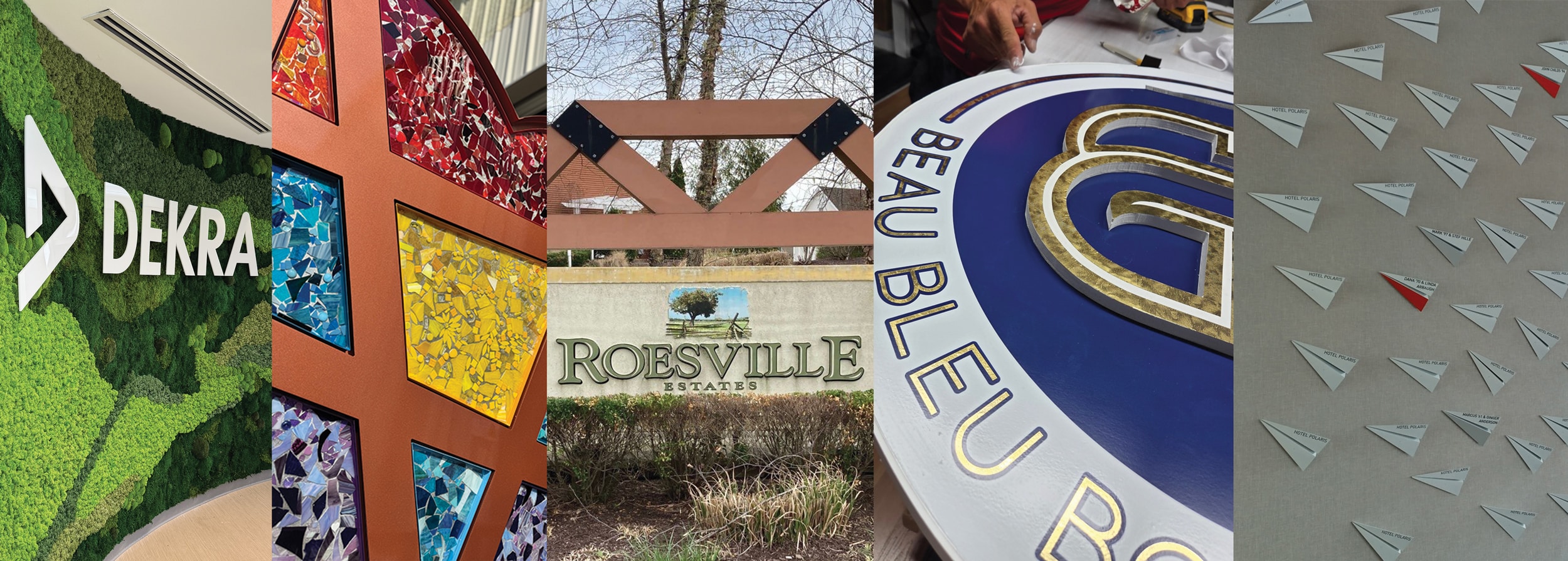
5 Bold Dimensional Signs
Outside-the-box thinking meets creative materials.

DIMENSIONAL LETTERS AND shapes are ubiquitous in the sign world, for good reason. They stand out — literally — from the background or surface to which they are affixed, clearly spelling out the names of the businesses and drawing attention with strong outlines and colors. The dimensional signs by these five signshops weren’t just well-made to suit their customers’ purposes: They utilized custom components, repurposed parts, creative techniques and bold ideas to truly rise above.

The shop designed a sign that would meet goldleaf and 3D requirements.
Golden Lesson
1 Nicki Tysta, the owner of Beau Bleu Boutique & Gifts (Bristol, RI) and longtime customer of hometown Hill House Graphics, contacted the shop to create a sign for their new location at Bowen’s Wharf in Newport, RI. Using the customer’s intertwining logo, Hill House designed the sign in a way that would meet the area requirements of goldleaf and three-dimensionality. They created the vector files in Adobe Illustrator, which they input into V-Carve Pro for the CNC components and ONYX for the background.
The shop fabricated the base from two pieces plus the logo on their ezRouter CNC machine, then printed the art on their Epson S40600 eco-solvent printer and cut the gold lettering on their Summa 54-in. cutter/plotter. To install the sign, they used a standard steel scroll bracket, a couple lengths of chain, and shackles that mounted to a custom-fabricated steel hanging structure built into the sign’s center. It ended up a very straightforward project after a bit of planning on the structure and fabrication process, Hill House Graphics owner Ian McClellan recalls.
“We really loved how the ‘Real Gold’ 22k film looked on the finished product and how it catches the sunlight,” McClellan says. In addition to being a fun project, it allowed the shop’s newest member, Danny Liew, to get involved in every aspect of crafting a dimensional sign for the first time.

Each of these “paper planes” is cut and V-grooved aluminum.
Wings of Metal
2 Boyd Sign Systems (Englewood, CO) was in the midst of producing ADA and wayfinding signage for Hotel Polaris (Colorado Springs, CO) when the team was introduced to the donor wall. From there they worked directly with the US Air Force Academy Association & Foundation, who oversees the wall. “We’re always eager to take on projects that push creativity and engineering, and this donor wall was a great example of what’s possible,” comments Jay Hartzler of Boyd Sign.
The design was created by B&Co. (Milwaukee), an advertising studio that specializes in hospitality branding. The team fabricated each “paper plane” from aluminum cut and V-grooved on their CNC router, which was then hand-bent into its final shape. They applied Matthews Paint finish onto the “planes,” with each donor name produced using Rowmark material. The mounting brackets were cast in resin and also painted with Matthews Paint. The “planes” and brackets all came in three different sizes.
The shop’s installers mounted each bracket by hand, using screws along with silicone for additional strength and attaching the “planes” to the brackets using high-strength double-sided tape. Because the planes were installed across three separate hotel walls, Boyd Sign created a custom installation template to ensure accurate placement. The design company B&CO. also provided the wall layouts while Boyd Sign produced paper templates for the installers.
“The donor wall’s design is truly one-of-a-kind. Seeing B&Co.’s initial concepts was exciting, but watching it all come together during installation really showed how impactful the piece is,” Hartzler says. “It integrates beautifully with the Hotel Polaris aesthetic and honors the Air Force Academy in a meaningful way.”
The biggest challenge for the shop was determining the best fabrication and mounting method. As the donor wall needed to enable future donors without removing the main mounting brackets, creating a long-term, easily updatable system required careful planning and prototyping. Boyd Sign went through several fabrication concepts before settling on a solution that balanced durability, functionality and their production capabilities. For Hartzler, staying open-minded during the early design and fabrication stages was critical.
“Every donor wall comes with its own unique challenges, but the mission is always the same: deliver a high-quality, dynamic solution that can evolve with the property over time,” Hartzler adds. “We hope the details of this project inspire other signmakers to experiment, collaborate and embrace the unique challenges donor walls bring.”
Advertisement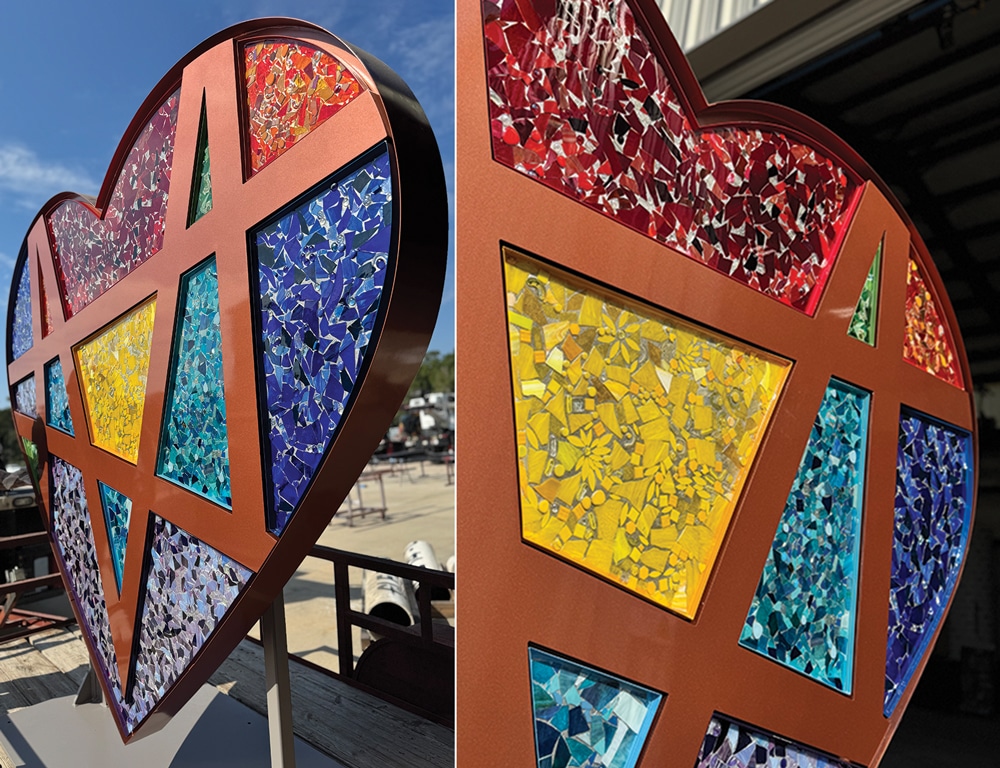
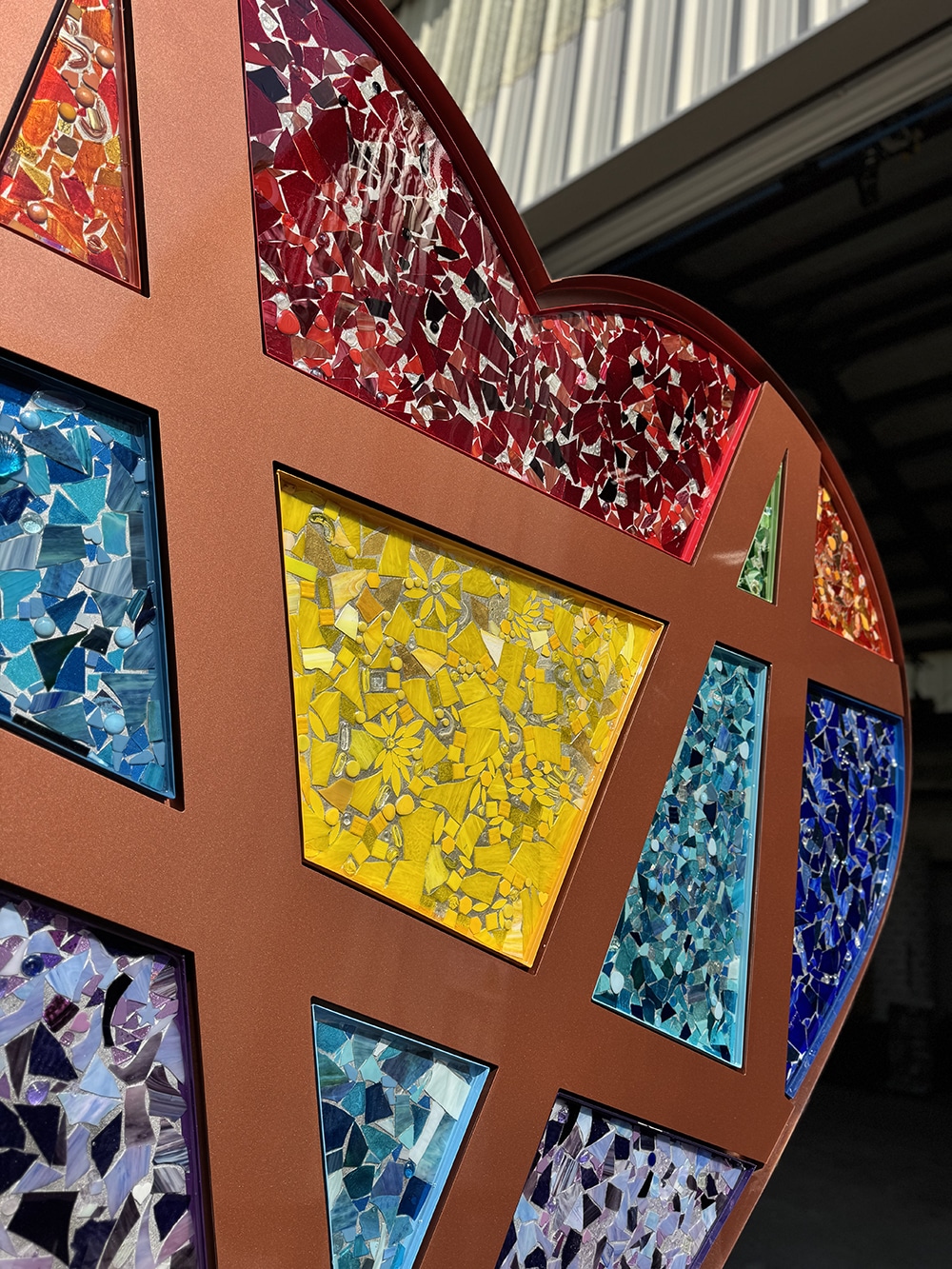
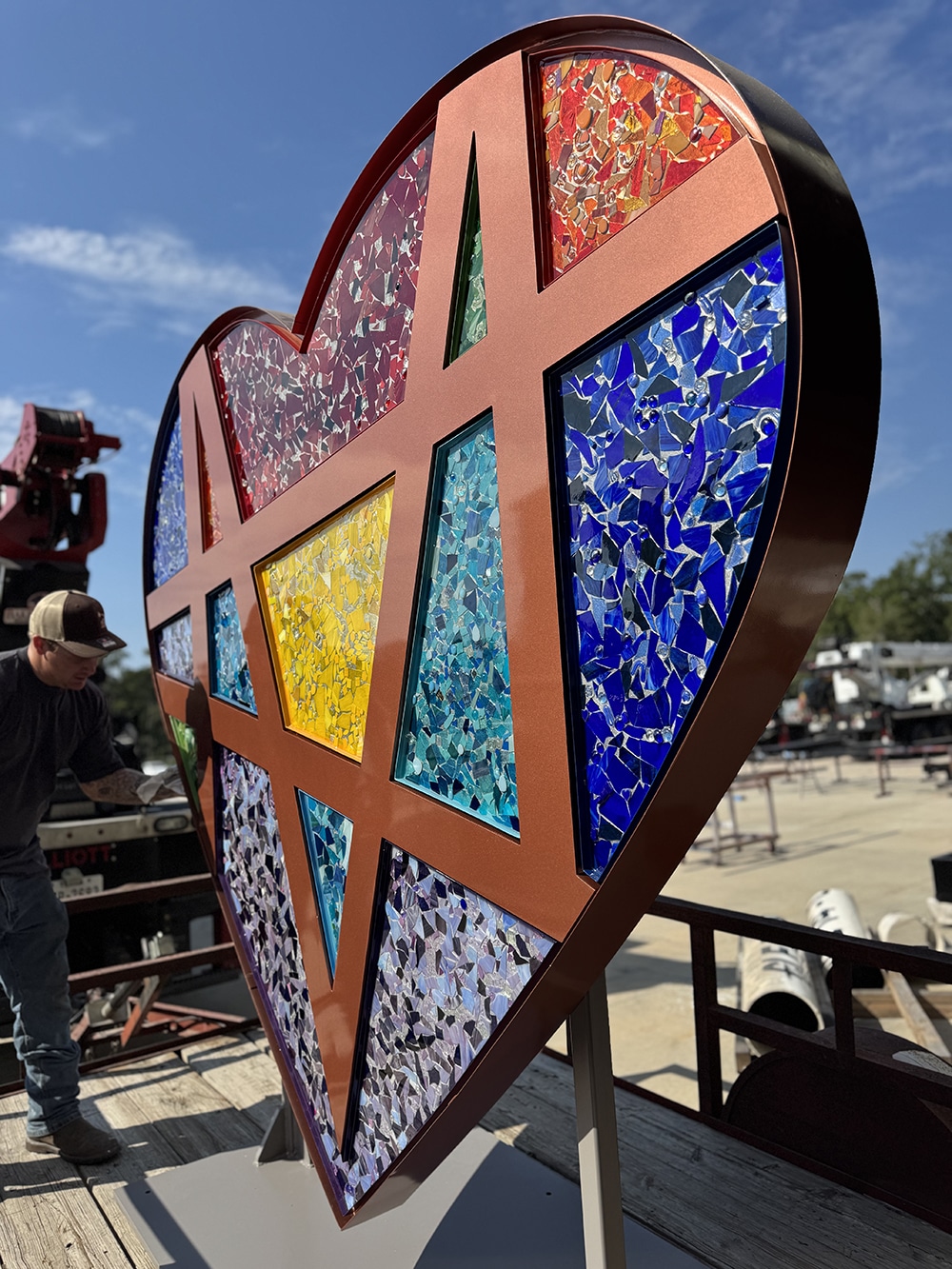
The stained glass pieces were repurposed from an old church.
Heart of Glass
3 On a congregation member’s recommendation, a church for which Bakers’ Signs & Mfg. (Conroe, TX) works provided the shop with the initial concept for a heart-shaped aluminum structure embedded with stained glass. The team developed the design further in CorelDRAW, then began the fabrication process with an aluminum can containing an open-face frame, which they created using their CR Onstrud router table plus “good old hand craftsmanship.”
They repurposed broken stained glass windows from an old church to populate the recessed openings within the faces, then backfilled the recesses with an epoxy for a 3D effect and a polished finish over the glass. The entire piece was painted with Matthews Paint system formula. It was something they had never done before but were able to take part in with confidence, recalls co-owner Matt Baker.
“The look of the finished stained glass, once done, was different from any piece that we had done before in that regard and we are really happy with how the end product came out,” he says. The dimensional piece was built with a counterweight at the bottom of the frame, making it a freestanding structure. When came time for installation, the shop used an Elliott crane truck to lift the piece into place for the church.
A final lesson that Baker wishes to impart to other signmakers is to take what might be considered one’s trash and turn it into art. “The potential that we have within our industry to push the bar in design, manufacturing and techniques … The machinery that we have combined with the talented artists within the design teams… I feel that there is no other industry better suited to bring these ideas and artist pieces to life!” he says.
Advertisement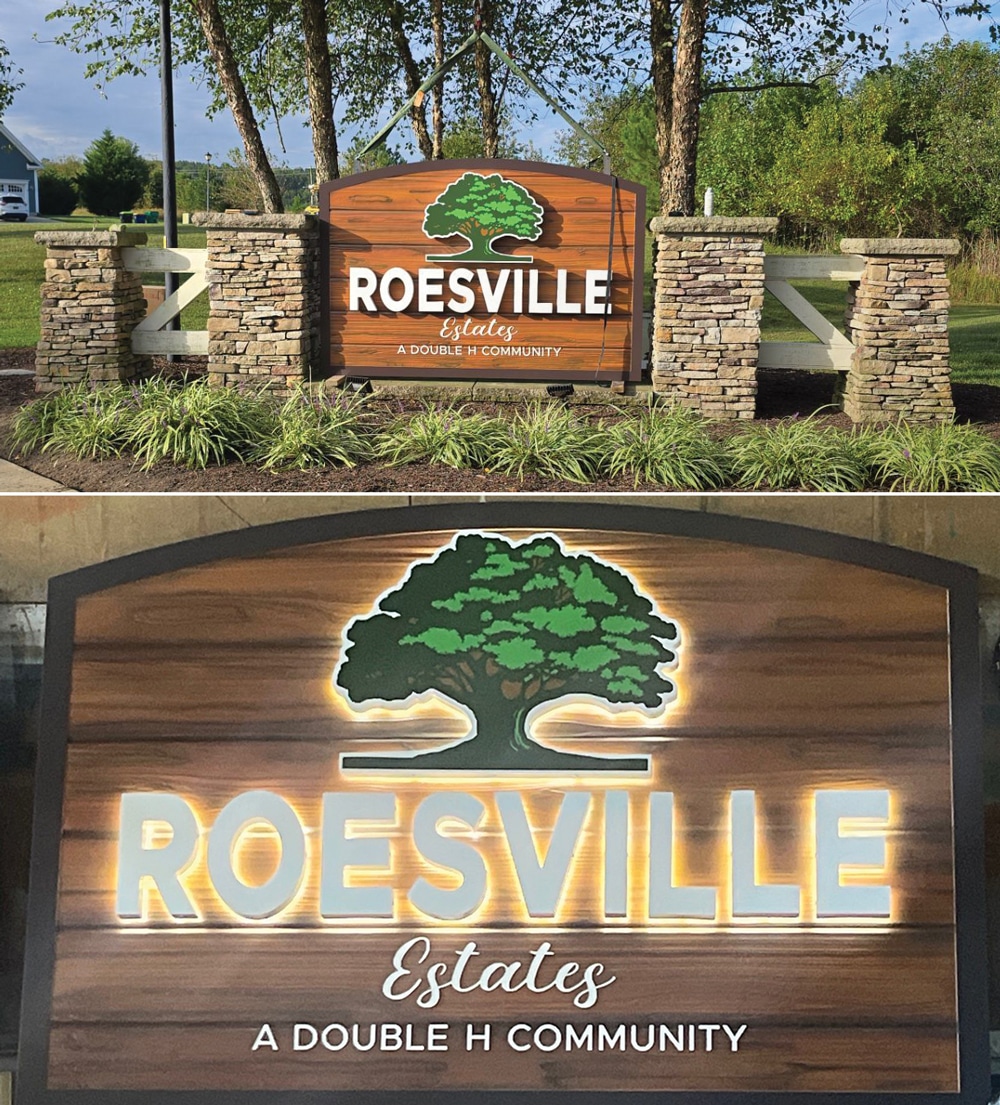
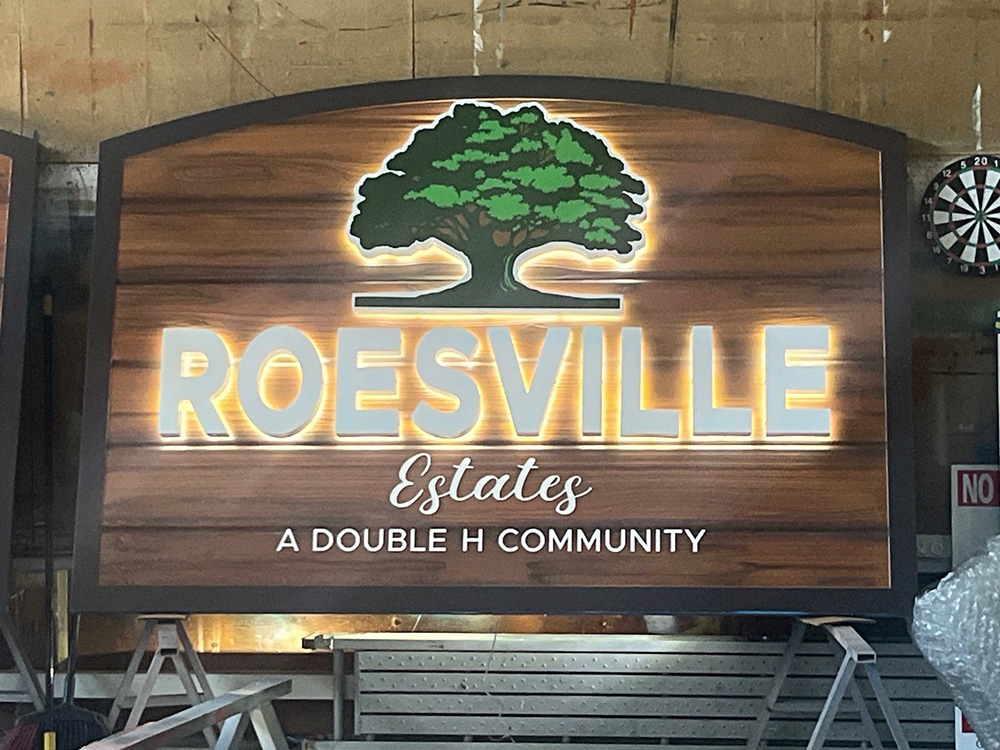
AkzoNobel primers and paints provided the color and finish for all the sign’s components.
Substrates on Deck
4 As the regular sign supplier for SeaScape Management (Millsboro, DE), Phillips Signs (Seaford, DE) was the go-to choice when the customer wanted to update the monument sign for the Roesville Estates (Felton, DE) living community. The shop used various software for the design, starting with initial files in Adobe Photoshop that became final working files in SAi Flexi. They then converted the router files in SAi EnRoute, which they cut on one of their Diversified Machine Systems (DMS) Freedom routers.
The Freedom was also used to route the ⅛-in. finish faces, with the 2-in. .063 mil finish returns bent on the shop’s SDS Automation channel bender. The team used a laser welder to weld the returns to the faces, which were painted with AkzoNobel primer and paint. HanleyLED lights and power supplies from Principal Sloan provided the internal illumination. The backgrounds were routed 1.5-in. Sign·Foam, which along with the welded aluminum frames were finished with AkzoNobel primer and paint.
Because the signs were heavy, Phillips Signs lifted them into place using one of their Elliott crane trucks. The frames were made to lock into the existing stone columns, where new lights were also installed. Conducting a thorough survey of the site and prior structure enabled the project to proceed smoothly, says the shop’s president Ben Phillips.
Although the combination of different substrates was a standout feature, Phillips was initially worried about how to emulate the look of wood grain for the backgrounds. “The grain we routed was done very well, so using a smaller spray gun I started layering thinned colors to get the cedar look, then finished by following the grain patterns with black to highlight them. Also added some free-handed knots,” he recalls. “Everyone was very happy with the final outcome.”
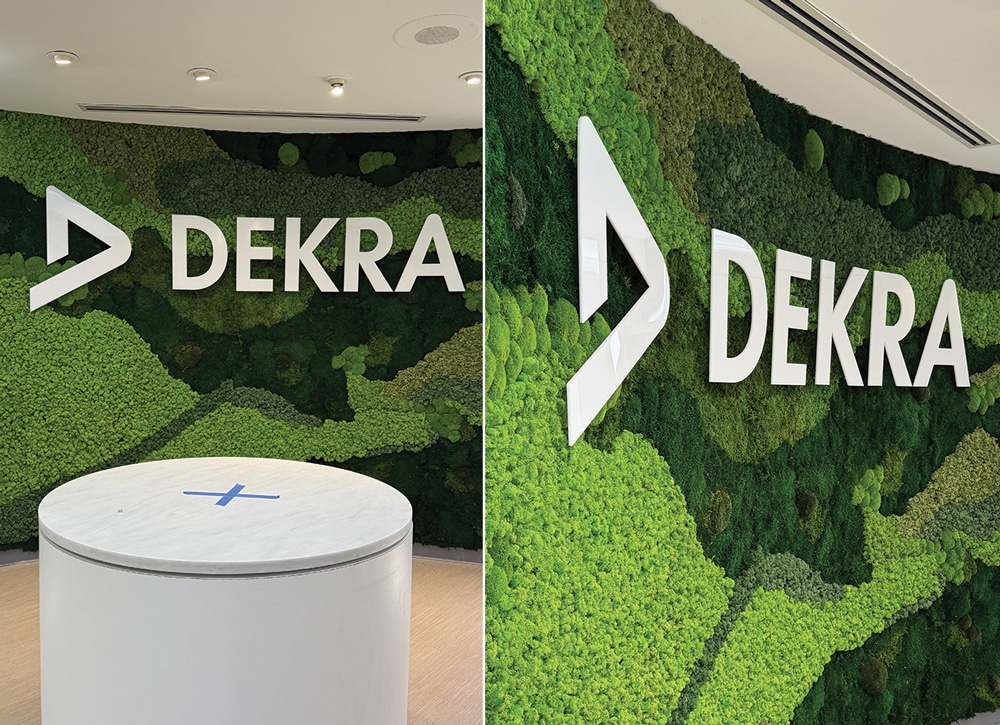
The minimalist letters created strong contrast against the preserved moss wall.
Clean and Green
5 Signarama Troy | Metro Detroit (Troy, MI) has provided a few sign projects for DEKRA North America (Atlanta), which offers services in vehicle inspection, product testing and certification. Naturally, when the company required a green faux-moss feature wall, they reached out to Signarama Troy | Metro Detroit lead sales representative Mike Stephens.
The shop designed the wall in Adobe Illustrator. Signarama designer Marissa Ciavone recommended a simple white logo in ⅜-in. dimensional acrylic, stud-mounted with 2-in. spacers, as keeping the sign clean and minimalist would allow the greenery to shine through and make the biggest impact on the space. The team eventually fabricated the logo piece from 3/16-in. white acrylic laser-cut on their Trotec SP500 for clean edges. Each element was embedded with studs and paired with spacers to create the dimensional stand-off effect during installation. The moss wall was created by Ambius (Reading, PA) from preserved live moss.
As the wall was curved and the moss varied in height from spot to spot, Signarama installation manager Steve Schneider notes that the install proved a bit tricky. Lining up the letters was also a time-consuming process because locating the drilled holes through the uneven moss took extra effort.
Nevertheless, once installed, the sign made for a bold contrast against the green wall. “It shows how simple, minimal lettering can make a big impact when paired with a strong, textured backdrop,” Stephens remarks, encouraging other signmakers to try new ideas and make bold choices. “Rely on your team — they’ll help you create the best result for the customer.”
PHOTO GALLERY (14 IMAGES)






Secrets of Lead Generation
Boost your sales by generating more leads! In this light and lively webinar featuring Maggie Harlow, CEO of Signarama Louisville Downtown (Louisville, KY) and the “Business of Signs” columnist for Signs of the Times, learn the secrets of how leads are generated, where they come from and how you can cultivate better (not just more) leads.





Bulletins
Get the most important news and business ideas from Signs of the Times magazine's news bulletin.
-

 Business Management2 weeks ago
Alternative Management Advice for Sign Companies
-
 Fabrication + Installation2 weeks ago
Small Signshop, Big Fabrication
-

 Real Deal1 week ago
Sign Company and Customer Clash on “Minimum 2 Hours”
-

 Benchmarks5 days ago
5 High-Performance Vehicle Graphics Projects
-
 Paul Ingle5 days ago
120 Years of Signs, and I’ve Seen 41 (Mostly)
-

 Tip Sheet7 days ago
Workflow Automation, Budget Discussion and More Signshop Tips
-

 Editor's Note1 week ago
Consider the Alternative
-
 News1 week ago
New Delco, PA Sign is “Damn Good”