Fabrication + Installation
Engineering a Safer Sign Installation Fleet
How Carolina Signs and Wonders and UNC Charlotte solved a hidden bucket truck hazard.

Editor’s Note: This article was written and sent to us to share with our readers by Todd Golbus, managing director of Carolina Signs and Wonders (Charlotte, NC).
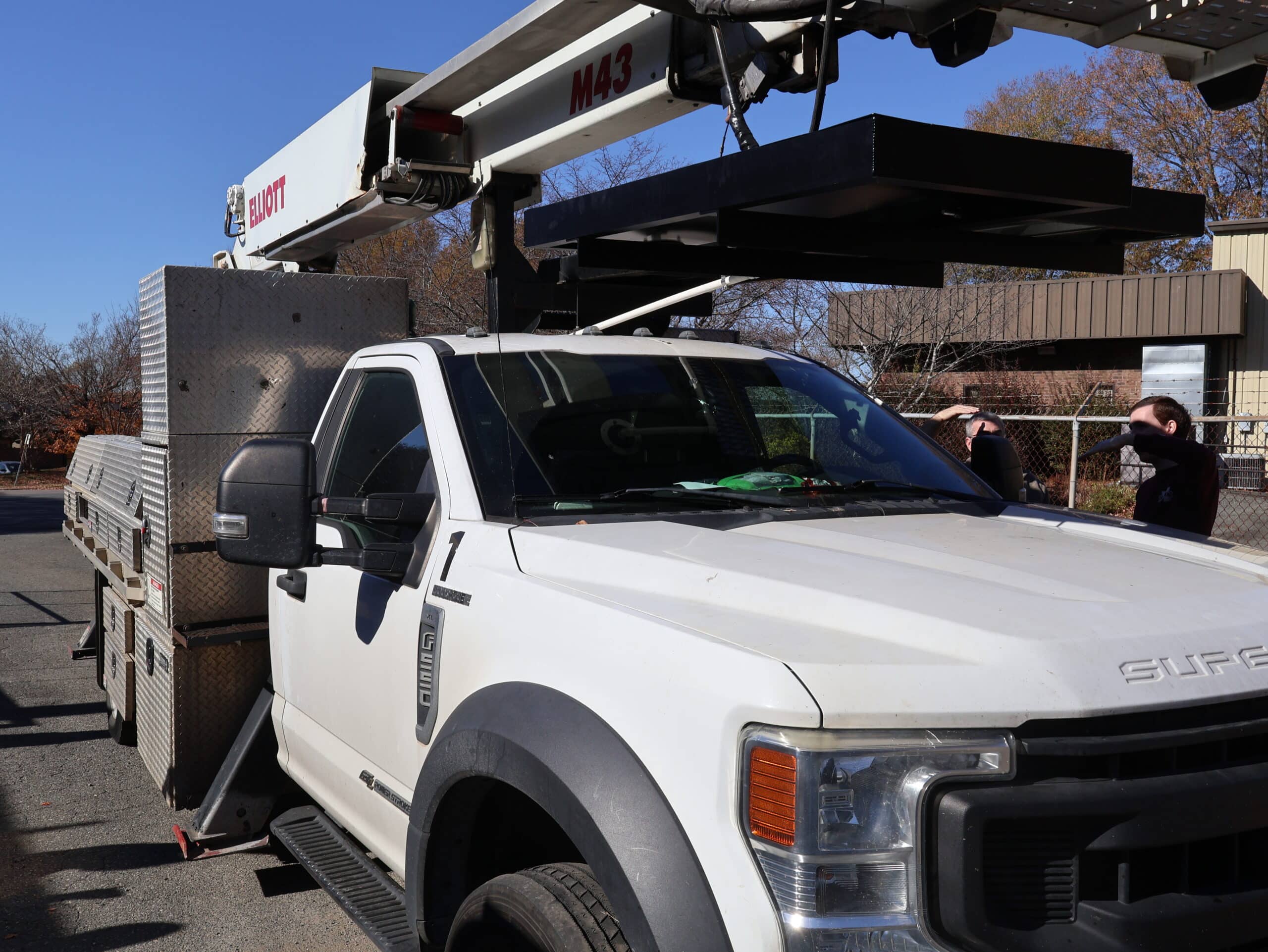
ACROSS THE SIGN industry, bucket trucks are synonymous with productivity. They lift installers for high-rise channel letters, digital signage, maintenance and architectural sign installations. However, they also share a stubborn flaw: Grease and hydraulic oil constantly drip from the boom knuckle onto the windshield — a problem that has challenged sign companies for decades.
The bucket assembly sits directly above the cab, so fluids fall into the driver’s line of sight. Windshield wipers smear the mess rather than clear it, compromising visibility. Technicians have long resorted to makeshift solutions: over-cleaning, protective films, extra washer fluid, even cardboard shields — but none of these options has proven to work reliably.
Carolina Signs and Wonders, headquartered in Charlotte, NC, and known throughout the Southeast for executing large, complex signage projects, decided it was time to engineer a permanent fix.
Partnering with UNC Charlotte’s Industrial Solution Lab
Carolina Signs and Wonders partnered with the Industrial Solutions Lab of the William States Lee College of Engineering at the University of North Carolina at Charlotte to transform an industry-wide challenge into a senior design project, connecting mechanical engineering students with real commercial problems to deliver fully tested, high-impact solutions.
UNC Charlotte’s five-person engineering team — Christopher Kirsch (PL), Ashlyn Linville, Connor Pencola, Harrison DeWeese and Sergio Preciado-Saldana — accepted the challenge with support from faculty mentor Dr. Jonathan Beaman and Carolina Signs and Wonders industry stakeholders.
“The students immediately understood the importance of the problem,” says Kevin Putman, operations manager at Carolina Signs and Wonders. “Our bucket trucks are on the road every day. When visibility is compromised, so is safety.”
Operating within constraints such as weight limits, DOT dimensional requirements, vibration and non-interference with bucket movement, the engineering team created a durable yet practical, field-tested solution.
Advertisement
A Three-Part Solution Engineered for Real-World Conditions
After months of modeling, prototyping and field evaluation, the UNC Charlotte team delivered a fully engineered, commercial-ready solution:

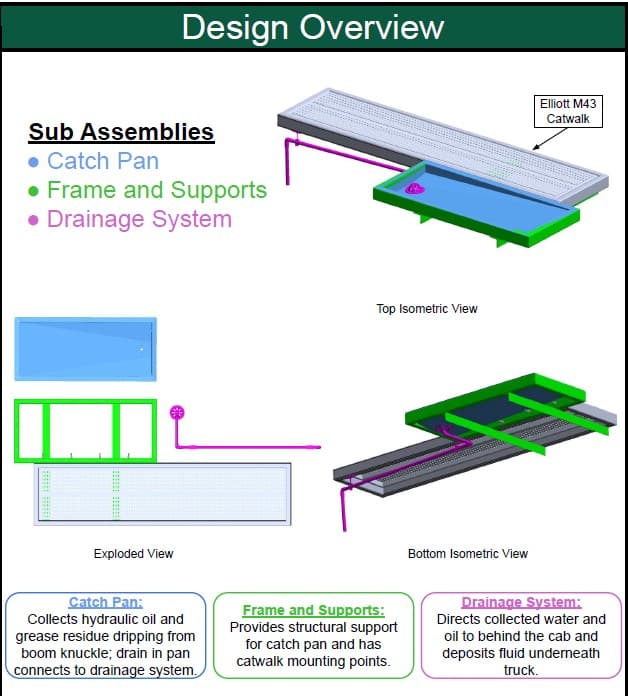
1. A Sloped Aluminum Catch Pan
Fabricated from CNC-cut-and-formed 3003 aluminum, the pan captures runoff beneath the boom knuckle. The pan is sloped to 4° towards the drain to ensure controlled fluid movement during operation.
2. A Reinforced Aluminum Frame
Constructed from 6063 aluminum rectangular tubing, the frame houses the pan and mounts to the catwalk using a vibration-dampening neoprene layer. It preserves full bucket motion, service accessibility and inspection points.
3. A PVC Drainage System
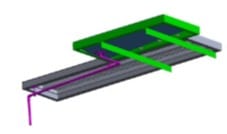
Integrated-PVC plumbing routes the runoff behind the cab, depositing it safely beneath the vehicle and preventing visibility issues.
Weighing only 60.4 lbs., the system performed flawlessly during vibration, drainage and wiper-operation tests.
Simple in concept but exceptional in execution is exactly the type of engineering we love to see. The students designed a system that works in all weather conditions, doesn’t interfere with our operations, and dramatically increases safety for our installers.
A Real-World Fix That’s Already Making a Difference
Carolina Signs and Wonders deployed the prototype on an Elliott M43 bucket truck for real job-site testing, and operators immediately saw an improvement. “Driving in the rain used to mean slowing down, pulling over and cleaning the glass,” says Colton Braun, senior installation technician. “With the system installed, the windshield stays clear on long drives between job sites. It’s a huge upgrade.”

What this Means for the Sign Industry
This project represents a milestone for sign companies everywhere. It exemplifies what can happen when fleet challenges are addressed through engineering, reinforcing the value of partnerships between sign manufacturers and academic engineering programs.
“It’s easy to accept certain headaches as ‘just part of the job,’” Putman says. “But when you step back and ask, ‘can this be engineered better?’, you often find the answer is ‘yes.’”
Carolina Signs and Wonders expects this design to become a fleet standard and hopes the innovation will inspire other companies to collaborate with similar engineering programs to solve industry-wide challenges.
For more information, contact Todd Golbus at [email protected] or Jim Hartman, Director of Industrial Solutions Lab, The William States Lee College of Engineering, UNC Charlotte at [email protected].
Advertisement

Secrets of Lead Generation
Boost your sales by generating more leads! In this light and lively webinar featuring Maggie Harlow, CEO of Signarama Louisville Downtown (Louisville, KY) and the “Business of Signs” columnist for Signs of the Times, learn the secrets of how leads are generated, where they come from and how you can cultivate better (not just more) leads.








Bulletins
Get the most important news and business ideas from Signs of the Times magazine's news bulletin.
-

 Buzz Session2 weeks ago
These 14 Sign Pros Prefer Their Good Old Days to Now
-

 Ask Signs of the Times2 weeks ago
How Soon Should Signshops Follow Up on Estimates?
-

 Ask Signs of the Times1 week ago
How Much Sign Companies Charge to Convert Logos
-

 Heidi Tillmanns1 week ago
Sign Legibility is Not a Style
-

 News2 weeks ago
New 130-ft. Marquee on Las Vegas Blvd.
-
 News2 weeks ago
Creative Sign Designs Celebrates Four Decades
-
 Paul Ingle5 days ago
120 Years of Signs, and I’ve Seen 41 (Mostly)
-

 Dale Salamacha1 week ago
A Gen Z’er Ready for Work