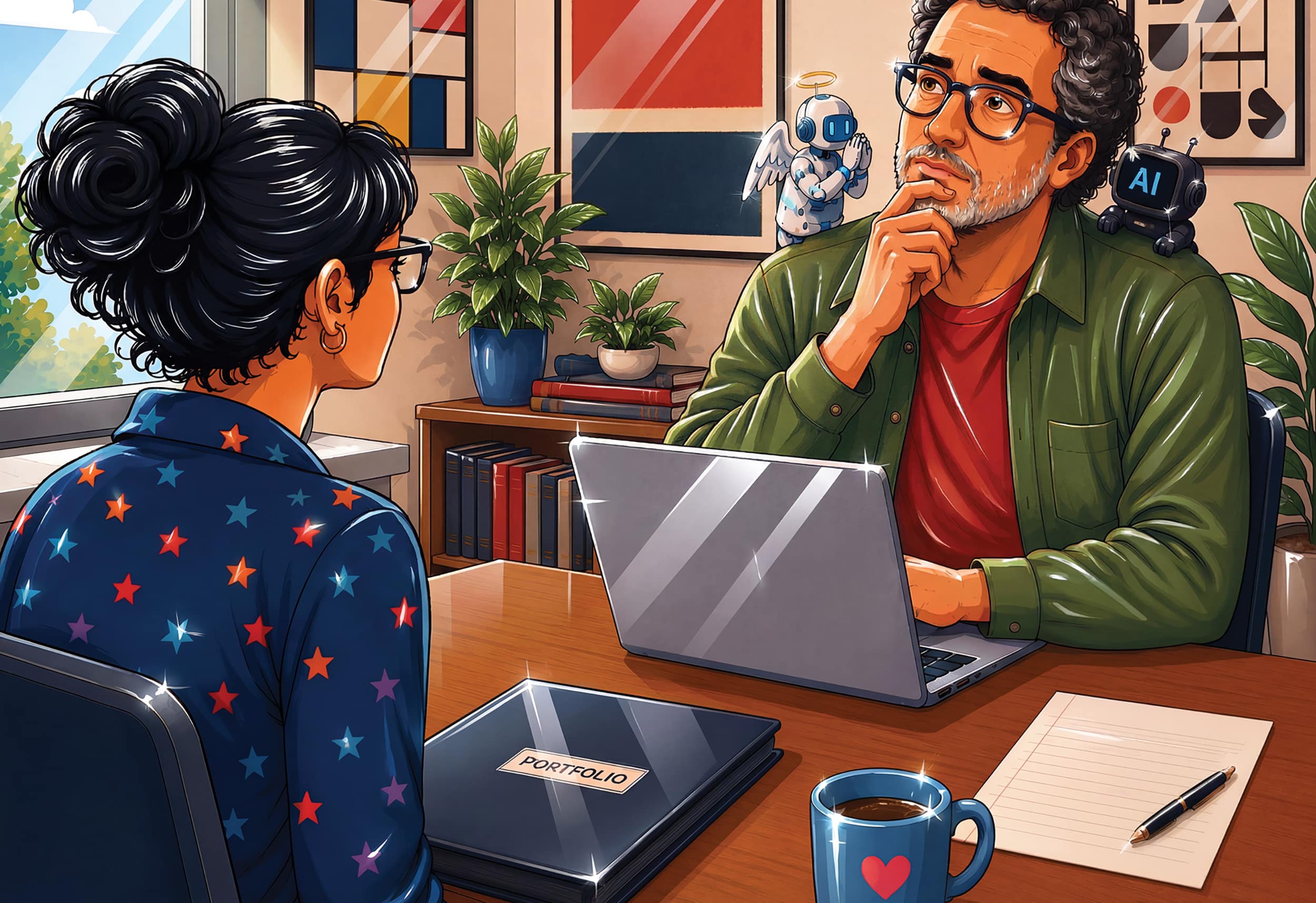
Young Applicant to Sign Company Fears Career’s Future
AI looms large in “The Case of Intelligence v. Artificial.”

SURE, IT LOOKS LIKE A good job, Daphne Le thought as she saw a position recently posted on LinkedIn. But how long would it last?
“Hiring entry-level graphic designer,” read the headline from Six-Seven Sign Co. in Kankakee, IL, a dozen miles south of where Daphne was living with her family until she got a job and could afford to share a place, or have one of her own.
ABOUT REAL DEAL
Real Deal scenarios are inspired by true stories, but are changed to sharpen the dilemmas involved and should not be confused with real people or places. Responses are peer-sourced opinions and are NOT a substitute for professional legal advice. Please contact your attorney if you any questions about an employee or customer situation in your own business.
ABOUT THE AUTHOR
Created by ROLF L’MAO, Signs of the Times’ mascot. Email him at editor@signsofthetimes.com.
Illustration of Rolf L’mao by Karina Marga Cuizon. Illustration for story by Victor Cantal
Daphne had recently graduated from the state university with a degree in graphic design. Like many in her class — not just the other graphic design majors — she worried how much AI would affect her career. She and her friends trashed the spread of “AI slop” and put on a brave face that it couldn’t approach the quality of their work.
Nevertheless, as a minor in the history of technology, Daphne was aware more than most of the pattern over time where jobs were threatened, reduced and eliminated by technological advancements. Moreover, the posting was one of very few she had seen in her area for months before receiving her degree in May.
“Well, let’s see what Six-Seven Sign Co. has to offer,” Daphne said to herself, and submitted the materials to apply for the position.
A week and a day later, Quentin St. John, manager of the design department at Six-Seven Sign, emailed Daphne to set up an interview within the next few days.
Daphne felt nervous anticipation as the interview date arrived. She spent a lot of time on the company’s website and social media, as well as trying to notice more about the signs around her when she went out.
Quentin met Daphne in Six-Seven Sign’s reception area and offered to show her around the office and shop before sitting down for the interview. “It’s important to know the materials, the build process, the installation details — all of that — for quality sign design.”
Daphne made a mental note about that for the interview coming up.
The tour ended in the design department: three full-time employees reporting to Quentin. “We ask a lot of our designers,” Quentin said to Daphne. “Our department goal is for our team to complete 15 designs per day, per designer. This will vary depending on the complexity of the work.” Daphne considered how much, or really, how little time that allowed per project.
“In general, our team meets that goal, even exceeds it at times,” Quentin said to Daphne, then to the room, “right guys?” The designers all looked up from their workstations and greeted Daphne cheerfully. “Hey, how’s it going?” and “We need the help, haha!”
“Okay,” Quentin said to them with a smile, then to Daphne, “Shall we go into my office and chat?”
“Sure,” Daphne said as she channeled nervousness into energy.
The interview began well. Quentin told Daphne he was impressed with her portfolio and not to worry that signs had not been part of it. One of the three designers in the department had graduated from the state university four years earlier. “You two have a very similar background,” Quentin said. “Plus, all four of us learned signs here on the job.”
Finally, the interview reached the point where Quentin asked, “Do you have any questions for me?”
“Yes,” Daphne replied. “I was wondering about the place and future of generative AI artwork here at Six-Seven Sign. I noticed earlier you mentioned that quality sign design takes into account the materials, the build process and even the installation. You also mentioned the rate of 15 designs per designer per day.”
Daphne paused to form her question carefully: “While AI seems unable to assist the former, it could definitely affect the latter… the number of designs per day. So, my question is, how do you currently use AI in design, and, to be honest, what would you say to someone like me, just starting her career and worried that AI will make my job obsolete?”
AdvertisementThe Big Question
- What would you say to Daphne about the future of careers in sign design if you were Quentin?
Daniel W.
Tucson, AZ
AI is a tool, just like a pencil or a paintbrush. Computers make the job easier in several ways. We expect AI to similarly aid our designers like any other tool. In a few years, your partnership with this new tool will seem as natural as using a computer. AI is not a threat; it’s an opportunity.
Matthew M.
Elgin, IL
AI is a regurgitator. It only knows what’s been done before, and tries to extrapolate from it. It should only be used in the base proofing process, not the completed work. It might save time on the general creation of generic orders, but will lack the incisive knowledge for more original projects and complex design campaigns. Whatever it generates is going to need to be checked for consistency and possible copyright.
Shane M.
Carthage, MS
I would encourage her to embrace AI as a tool for staying current and competitive as a graphic artist. Like other technological advances, AI improves productivity without replacing creativity. AI is no different than when digital clip art subscriptions replaced the old cut-and-paste books we once used. Those innovations didn’t replace designers. They simply made us more efficient. I use AI in my workflow to quickly create concepts, renderings and vendor mockups that would otherwise take much longer to produce. It helps communicate ideas, generate accurate quotes and identify the best production methods.
AI is here to stay. It is simply another tool in the toolbox and those who learn to use it effectively will benefit from its advantages. My father was a hand letterer and billboard artist who embraced vinyl graphics and digital printing. Technology evolves, but creativity, experience and artistic vision remain invaluable.
Want to comment on Real Deal scenarios, too? Sign up to receive the stories by email each month before they’re published at signsofthetimes.com/research.
Advertisement

Secrets of Lead Generation
Boost your sales by generating more leads! In this light and lively webinar featuring Maggie Harlow, CEO of Signarama Louisville Downtown (Louisville, KY) and the “Business of Signs” columnist for Signs of the Times, learn the secrets of how leads are generated, where they come from and how you can cultivate better (not just more) leads.









Bulletins
Get the most important news and business ideas from Signs of the Times magazine's news bulletin.
-

 Benchmarks2 weeks ago
5 High-Performance Vehicle Graphics Projects
-

 Buzz Session1 week ago
Sign Pros on Bidding Too High and Turning Down Projects
-
 Paul Ingle2 weeks ago
120 Years of Signs, and I’ve Seen 41 (Mostly)
-

 News1 week ago
PRINTING United Expo 2026 Preview
-

 News1 week ago
Dean Blazek “Follow the Signs” Book Available
-
 Signs of the Times1 week ago
August 1936 Signs of the Times Focused on Outdoor Advertising
-

 News1 week ago
Neon Baby Chick Sign in Petaluma, CA Restored
-

 Education6 days ago
Building Signs, Building People